
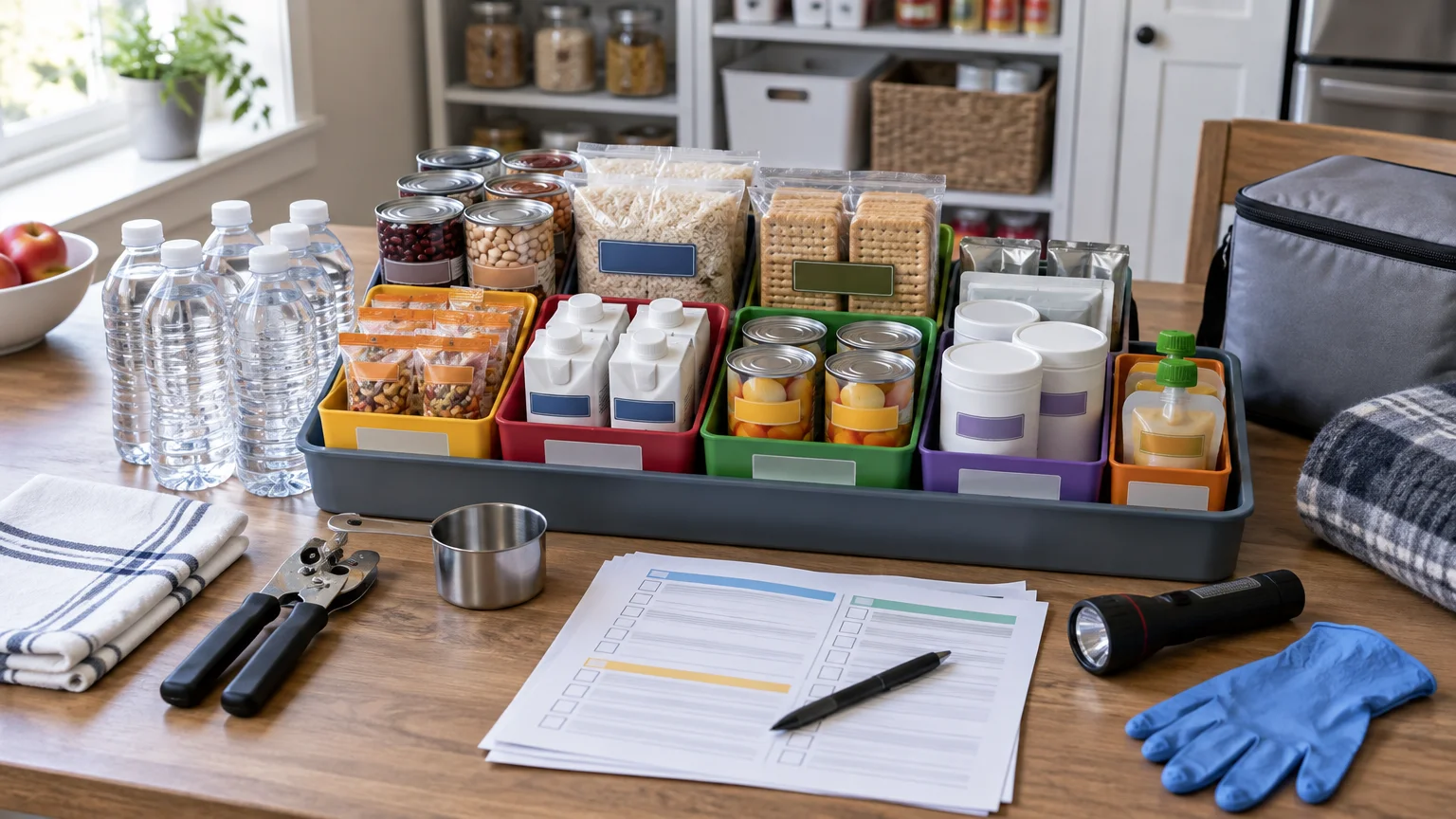
TLDR: The safest approach to emergency food special diets allergies is to plan by person, not from a generic survival-food list. Record what each household member can safely eat, create a simple menu using accepted shelf-stable foods, calculate the water and equipment that menu requires, and build separate evacuation and at-home supplies. Keep emergency medications and medical nutrition on their own plan, review every label when purchasing or rotating food, and prepare for refrigeration loss.
An emergency pantry is useful only if people can safely eat what is in it. A case of assorted meals may appear efficient, but it can fail someone with food allergies, diabetes, swallowing restrictions, kidney disease, sensory-related feeding needs, or another medically necessary diet. CDC specifically advises including specialty foods for dietary restrictions, allergies, sensitivities, and conditions such as diabetes in emergency supplies. It also identifies prescriptions, inhalers, and epinephrine auto-injectors as personal needs requiring advance planning.
The practical solution is a diet-first system. Start with each person’s established needs, turn familiar foods into a no-power menu, and then shop for that menu. This takes more thought than buying a preassembled food bucket, but it produces supplies the household is more likely to use safely during an evacuation or outage.
Create a one-page dietary emergency profile
Make one profile for every household member with a food restriction or specialized feeding need. A copy can stay with the food supply, while another can travel in the evacuation kit. For a child or dependent adult, give an updated copy to the person likely to provide care during an emergency.
- Name, date of birth, emergency contacts, and relevant clinicians
- Foods, ingredients, or allergens that must be avoided
- Familiar foods that are reliably safe and accepted
- The person’s usual meal and snack pattern
- Texture, portion, preparation, thickening, or feeding requirements
- Current prescriptions, emergency medications, and storage instructions
- Clinician-directed formula, supplements, tube-feeding products, or medical foods
- Symptoms caregivers should recognize and the established response plan
- Safe substitutes if a preferred food is unavailable
- Whether shared utensils, cookware, or preparation areas create an unacceptable cross-contact risk
This profile should reflect the person’s existing care plan rather than creating new medical rules for an emergency. Diabetes, kidney disease, dysphagia, tube feeding, severe allergies, and prescribed medical nutrition can involve requirements that a general preparedness checklist cannot determine. Confirm quantities, substitutions, storage limits, and emergency procedures with the appropriate clinician.
Choose a planning duration that fits the hazard
FoodSafety.gov recommends keeping at least a three-day emergency supply of food and water. The American Red Cross distinguishes between a three-day evacuation supply and a two-week at-home supply. These are useful starting points, not universal predictions of how long every disruption will last. FoodSafety.gov’s disaster food-safety guidance emphasizes foods requiring little or no cooking, water, or refrigeration.
Adjust the duration for local hazards, evacuation routes, utility reliability, available storage, household size, and the difficulty of replacing specialized products. A person dependent on a narrowly available formula or medical food may need a more deliberate resupply plan than someone who can eat common pantry staples.
| Planning factor | Evacuation supply | At-home supply |
|---|---|---|
| Primary goal | Portable food for immediate movement | Deeper reserve for sheltering through a disruption |
| Starting duration | At least three days | Work toward a longer reserve, such as two weeks, where practical |
| Food format | Compact, durable, ready to eat | Broader menu with canned and dry foods |
| Preparation | Prefer food edible without heat | May include cooked foods if backup equipment and safe water are available |
| Packaging | Small portions reduce leftovers | Larger packages may save space and cost |
| Storage location | Accessible and easy to carry | Cool, dry, organized household storage |
Do not let the evacuation supply become too heavy to move. Water, food, medication, documents, clothing, and accessibility equipment add up quickly. Coordinate the portable food module with the rest of your family emergency kit and decide who carries each item.
Make an emergency menu before buying food
Plan complete days of meals and snacks using foods the person already tolerates and eats. For each item, ask whether it can be eaten cold, whether it requires potable water, and whether opening or serving it requires a tool. USDA emergency guidance includes nonperishable food, bottled water, a manual can opener, infant formula, pet food, and special-diet foods among the supplies households should consider.
A useful menu might combine a safe ready-to-eat breakfast, individually packaged snacks, a shelf-stable lunch, and a canned or pouched dinner. The exact foods must come from the individual’s dietary plan and current product labels. There is no universal list that is safe for every allergy or special diet.
- Prioritize familiar foods that have been tolerated before the emergency.
- Include enough calories and meal variety for the planned duration without depending on unfamiliar substitutions.
- Favor at least some foods that require no heat, refrigeration, or added water.
- Match package size to the number of people who can safely eat the product.
- Pack a manual can opener if any cans lack pull tabs.
- Include clean utensils, cups, napkins, waste bags, and any required feeding equipment.
- Write the required water beside every dehydrated meal, powdered drink, formula, or medical product.
- Test the menu during an ordinary day, without changing medically directed preparation procedures.
A rehearsal often exposes hidden dependencies: a can without an opener, a meal that consumes significant water, a product the child refuses, or a food that cannot be prepared safely on shared cookware. Correcting those problems before an emergency is easier than improvising during one.
Read labels and control cross-contact
In the United States, packaged-food labels must identify the food source of nine major allergens: milk, egg, fish, Crustacean shellfish, tree nuts, peanuts, wheat, soybeans, and sesame. FDA also explains that advisory statements such as “may contain” are voluntary and do not follow mandatory standardized criteria for when or how they are used. FDA’s food-allergy labeling guidance provides the regulatory details.
A missing “may contain” statement is therefore not a blanket guarantee against cross-contact. Follow the affected person’s established avoidance plan, including any rules supplied by an allergist or other clinician. Do not adopt a less cautious threshold simply because emergency food choices are limited.
- Keep food in its original labeled packaging whenever practical.
- Read the complete current label every time a product is bought or rotated; ingredients and manufacturing disclosures can change.
- Mark designated food clearly and store it in a separate bin if that supports the person’s cross-contact plan.
- Do not place leaking, opened, or damaged products with protected foods.
- Pack dedicated preparation or feeding equipment when shared equipment is not acceptable.
- Teach all likely caregivers where safe food and emergency treatment are stored.
- Record product substitutions instead of assuming similar-looking varieties have identical ingredients.
Food and emergency treatment should remain separate planning categories. A supply of safe food does not replace epinephrine, prescriptions, glucose-management supplies, inhalers, or a written response plan. Review medication quantities, refill timing, temperature requirements, and evacuation storage with the prescribing clinician or pharmacist.
Calculate water alongside the menu
FoodSafety.gov advises storing at least one gallon of water per person and pet per day, with additional water considered for hot climates, pregnancy, or illness. Salty and spicy foods can also increase drinking-water needs.
Use this baseline calculation: number of people and pets × planned days × one gallon. For example, two adults, one child, and one pet over three days produces a starting figure of 12 gallons. Then add water required for formula, rehydrated food, medical nutrition, sanitation, and any other household-specific need. A pet’s actual needs vary by species and size, so discuss unusual requirements with a veterinarian rather than treating the general baseline as a precise prescription.
This calculation can change the menu. Dry staples may store efficiently but become impractical when water is scarce. A balanced supply includes foods that can be eaten without preparation, preserving stored water for drinking and essential hygiene.
Plan for a power outage before refrigerated food warms
Specialty products that require refrigeration need a backup plan. CDC says an unopened refrigerator generally keeps food cold for up to four hours. A full freezer holds temperature for about 48 hours, while a half-full freezer does so for about 24 hours. Appliance thermometers, coolers, and ice can help manage food, but CDC advises never tasting food to decide whether it is safe. CDC’s emergency food-safety instructions explain what to keep and discard after temperature control is lost.
Keep refrigerator and freezer doors closed during an outage. Know which specialty foods must be transferred first and how long their manufacturer or clinician allows them to remain outside the required temperature range. If safe storage cannot be confirmed, use the shelf-stable emergency menu instead of taking a chance.
Food safety is only one outage concern. Phones may be needed to contact clinicians, pharmacies, utilities, shelters, and emergency services, so include those communications in an emergency phone charging plan.
Plan separately for infants, medical foods, and pets
Infants require a feeding plan based on their normal method and current professional guidance. Store the appropriate formula or feeding supplies, the safe water and equipment required for preparation, and enough cleaning supplies for the conditions you expect. Do not substitute a different formula during an emergency without appropriate medical guidance. USDA notes that infant formula is a notable exception among shelf-stable products for which date instructions require particular attention.
Clinician-prescribed formula, tube-feeding products, thickeners, electrolyte products, and other medical nutrition may have specialized preparation and storage instructions. Track these separately from ordinary groceries, including the daily quantity, water requirement, equipment, power dependency, prescription or ordering details, and backup supplier contact.
Pets also need their own food, water, bowls, medications, carrier or restraint, and records. Store food compatible with the animal’s normal diet, especially when a veterinarian has prescribed a therapeutic formula. Confirm in advance which local shelters or evacuation facilities accept pets and what supplies they expect owners to bring.
Use a recurring rotation and review routine
Emergency food should be an organized extension of household food, not a forgotten box. USDA recommends periodically rotating emergency supplies. Dates on many shelf-stable foods relate to quality rather than serving as universal safety cutoffs, but package instructions still matter, and compromised packaging should be discarded.
- Monthly: check medication quantities, recalls, and near-term clinical or dietary changes.
- Every three to six months: inspect packaging, replace damaged items, review labels, and rotate foods approaching the household’s chosen use date.
- When clocks change or seasons shift: verify water, manual openers, utensils, thermometers, coolers, and backup cooking equipment.
- After any diagnosis or care-plan update: revise the dietary profile and replace incompatible food.
- After using the kit: replenish it immediately and record any item that was difficult to prepare or was not accepted.
A compact planning worksheet
Use the following worksheet for each person with a restricted diet. It can also serve as the shopping and review checklist.
- Profile: foods to avoid, reliably safe foods, preparation and texture needs, emergency contacts, and care-plan location
- Duration: evacuation days, at-home days, and the local disruption that each supply is intended to cover
- Menu: breakfast, lunch, dinner, snacks, and required medical nutrition for each day
- Dependencies: water, heat, refrigeration, electricity, utensils, sanitation, and caregiver assistance
- Water: baseline drinking supply plus food preparation, medical, pet, and sanitation needs
- Treatment: prescriptions, epinephrine, inhalers, monitoring supplies, written instructions, and refill dates
- Storage: evacuation bag location, at-home bin location, temperature limits, and designated safe-food controls
- Rotation: next label review, food replacement date, medication check, and practice date
- Local confirmation: evacuation destination, dietary accommodation contact, pet policy, pharmacy options, and transportation plan
Build the first three days, then improve the plan
Start by writing one dietary emergency profile and a three-day menu for each affected person. Buy the safe food that menu requires, calculate its water and equipment dependencies, and pack a portable version separately from the home reserve. Then extend the at-home supply as storage, budget, local hazards, and medical needs allow.
The strongest plan is not the one with the longest shelf life or the most packages. It is the one household members can identify, prepare, and safely eat under difficult conditions—and that caregivers can follow without guessing.
References
- Personal Needs | Prepare Your Health | CDC
- Food Safety in a Disaster or Emergency | FoodSafety.gov
- What Do You Need In a Survival Kit | American Red Cross
- What foods should I keep in my house for emergencies?
- Food Allergies | FDA
- Keep Food Safe After a Disaster or Emergency | Food Safety | CDC
- Shelf-Stable Food Safety | Food Safety and Inspection Service