
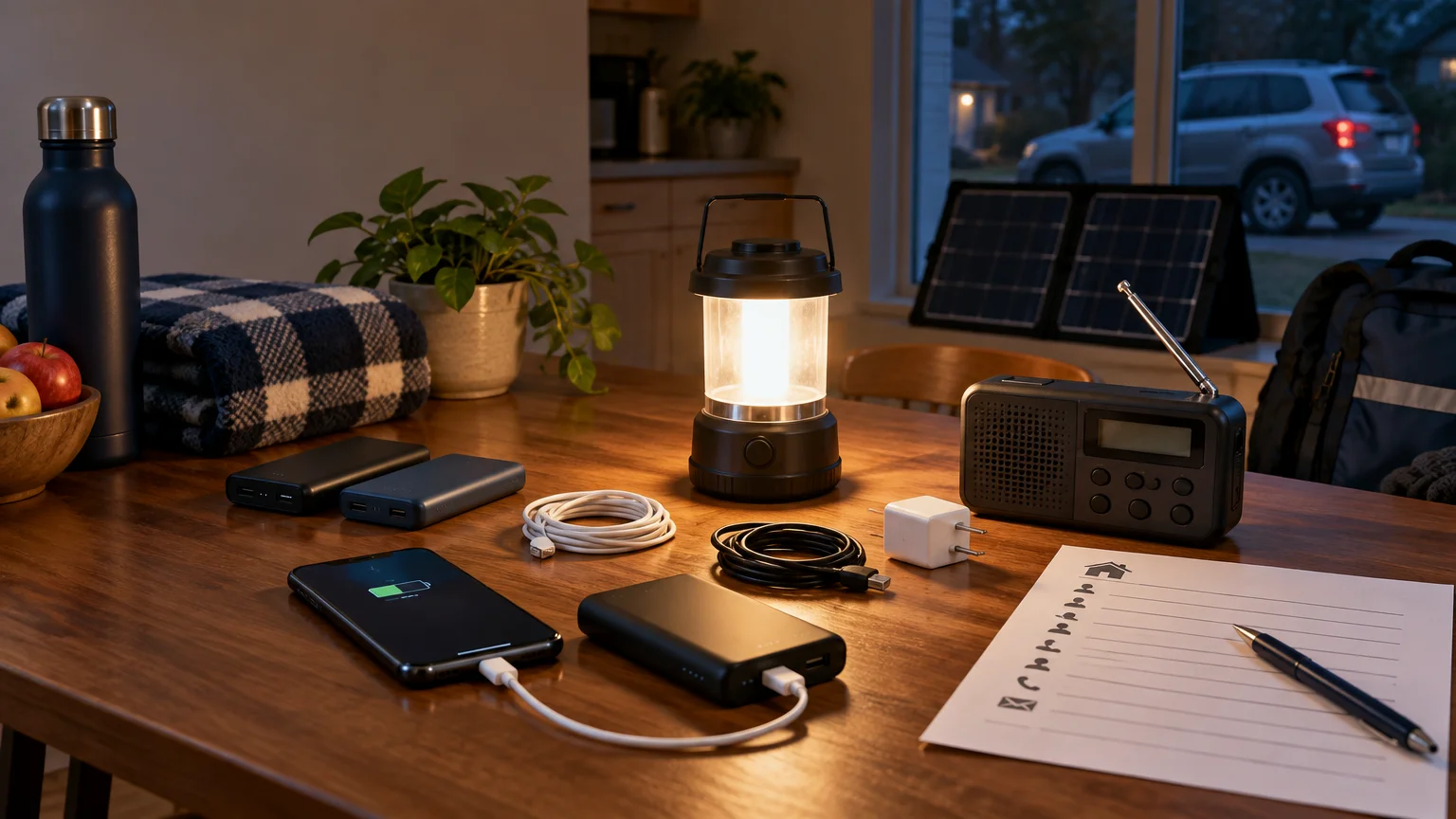
Emergency Phone Charging Plan for a Multi-Day Outage
TLDR: A practical emergency phone charging power outage plan prioritizes one or two essential phones, measures power needs through a home test, and reserves stored battery capacity for communication. Add vehicle or solar charging only as supplemental layers. Because a charged phone may still lose cellular data or internet access, keep a weather radio, printed contacts, meeting places, and local alert information available.
The goal is not to keep every household device at 100%. It is to preserve enough power for essential calls, messages, alerts, and scheduled check-ins throughout the outage. Start with charged power banks, assign device priorities, conserve phone batteries, and decide in advance when lower-priority devices must wait.
A charged phone is only one part of the plan
Phone power and communication access are separate problems. Cellular networks, home internet equipment, and other communications systems depend on electricity and supporting infrastructure. A charged phone therefore does not guarantee that calls, texts, data, or internet-based messaging will work during a broad outage.
Build the plan around three needs: energy for priority devices, multiple ways to receive information, and a household procedure for reconnecting if networks fail. Ready.gov recommends planning alternative phone-charging methods and creating a family communication plan with contacts, meeting places, and an out-of-town contact. Its emergency planning resources provide a useful starting point.
Charging cables, power banks, a battery-powered radio, and printed records also belong in a broader family emergency kit. Keeping them together prevents a working battery pack from becoming useless because the correct cable is missing.
Take a 10-minute device and cable inventory
List the equipment your household might try to charge, then assign each item a role. This turns an informal collection of batteries and cables into a power plan.
| Priority | Typical devices | Charging rule |
|---|---|---|
| Priority 1 | Primary phone, accessibility-related communication device, essential medical communication phone | Maintain a planned reserve and charge first |
| Priority 2 | Second household phone, weather radio with rechargeable battery, basic lighting | Charge after Priority 1 needs are covered |
| Priority 3 | Tablets, headphones, entertainment devices and nonessential accessories | Wait until power availability is clear |
Device roles should reflect the household rather than ownership. The newest or most expensive phone does not automatically come first. The priority phone should have the necessary contact information and alert apps, reliable battery health, and a user who understands the plan.
Record the cable and charging input for every priority device. Label unfamiliar cables and place compatible wall adapters, vehicle adapters, and short spare cables with the power banks. The Department of Energy recommends having charging cables and spare battery resources available before an outage.
Set an emergency phone charging power outage budget
Use watt-hours, abbreviated Wh, when that rating is available. Watt-hours provide a common way to inventory stored energy across power banks and larger battery systems. A milliamp-hour rating by itself is less useful for comparing unlike batteries because voltage is also part of the energy calculation.
- Write down the rated watt-hours of each power bank or battery system. If only milliamp-hours are shown, check the manufacturer’s documentation rather than assuming two similarly labeled products store the same usable energy.
- Fully charge the priority phone and use it normally for a planned 24-hour outage drill. Record its starting and ending battery percentages and note unusually heavy calling, navigation, hotspot, or video use.
- Recharge the phone from the power bank and record how much of the bank’s displayed capacity was consumed, if the bank provides a useful display.
- Repeat the test with the second priority phone and other essential rechargeable devices.
- Use the results to decide how many days the existing equipment can support while preserving a final emergency reserve.
Treat every advertised capacity as an upper limit, not a promise of a particular number of phone charges. Phone battery size and health, charging equipment, temperature, usage, and energy lost during conversion all affect the result. A controlled household drill is more useful than a universal claim such as “this bank charges any phone five times.”
If the test shows that one power bank restores the priority phone twice under realistic conditions, plan around that observed result while leaving a reserve. Do not assume the same result for another phone or a future outage. Repeat the test after replacing a phone, cable, or battery pack.
Build several charging layers
A resilient system does not depend on one power bank or one charging method. Use stored power first because it works immediately and does not require fuel, sunlight, or a running vehicle.
Layer 1: Pre-charged power banks
Keep at least one bank assigned to communications rather than everyday entertainment. Separate banks can provide useful redundancy: one failure, missing cable, or depleted pack will not consume the household’s entire reserve.
Layer 2: Vehicle charging
A vehicle adapter can provide supplemental charging when conditions permit, but it should not be the only plan. If the vehicle must run, the Department of Energy says it should be outside the garage with attention to ventilation. Never run a vehicle in a garage, even with the garage door open.
Store an appropriate vehicle adapter and cable with the household’s travel supplies or vehicle emergency supplies. Check the owner’s manual to understand whether an outlet works with the engine off and avoid draining the starting battery.
Layer 3: Solar or a larger battery system
Portable solar panels and larger battery systems can extend an outage plan, but their usefulness depends on equipment compatibility, weather, placement, and actual output. Treat solar as conditional supplemental capacity, not guaranteed daily energy. Test the complete combination—panel, controller or battery, cable, and phone—before relying on it.
Follow all manufacturer instructions for power banks and larger batteries. Inspect equipment for damage, swelling, overheating, unusual odor, or other warning signs, and stop using questionable equipment. The Consumer Product Safety Commission documents relevant battery safety standards and recalls involving lithium-ion power banks, so include a recall check in routine maintenance.
Use a fixed charging and check-in routine
Unplanned use can drain a carefully assembled battery reserve. Establish simple household rules that remain easy to follow under stress.
- Designate one phone as the primary communications device.
- Choose brief check-in windows, such as morning and evening, instead of repeatedly refreshing news and social feeds.
- Charge according to priority rather than giving every device a small amount of power.
- Set a reserve level that cannot be used for entertainment or routine browsing.
- Keep calls brief when networks are available, and use only the communication method appropriate to current local conditions.
- Write each recharge in a paper log so everyone knows how much stored capacity remains.
Reduce demand before reaching for another battery. The Department of Energy recommends lowering screen brightness, using airplane mode when appropriate, closing unused applications, and keeping calls brief to conserve mobile-device power. Airplane mode prevents normal cellular communication while enabled, so turn it off during planned network checks or when a call is expected.
Download any essential information before severe weather arrives, but do not assume cached information will remain current. Keep navigation, entertainment, hotspot use, and video off the priority phone unless they are needed for safety or an essential task.
Prepare for network and internet failure
A household communication plan should have several pathways. CISA uses a Primary, Alternate, Contingency, Emergency framework for emergency communications planning and emphasizes redundancy and exercises. A household can borrow the basic idea without treating it as a consumer standard.
| Path | Household example | Limitation to plan for |
|---|---|---|
| Primary | Voice call or household messaging method | Cellular or data service may be disrupted |
| Alternate | Local text alerts and utility notifications | Enrollment and network delivery are required |
| Contingency | Compatible battery-powered NOAA Weather Radio receiver | Reception depends on local coverage and conditions |
| Emergency | Printed contacts, meeting places and an out-of-town contact | Household members must know when to use the plan |
The American Red Cross recommends backup phone charging, local text-alert enrollment, a radio that works without household power, a paper contact list, and a support network for outage preparation. NOAA Weather Radio All Hazards provides continuous broadcasts that can include weather warnings and other emergency information, but receiving them requires a compatible receiver and adequate local reception.
Enroll in local emergency alerts and utility outage notifications before an incident. Then test the weather radio from the place where it will normally be used. Store spare batteries if the model accepts them, and write the tuning or operating instructions on a card.
Create a printed outage packet
A paper packet remains usable when phones are dead, locked, misplaced, or disconnected. Give each household member the information appropriate for their age and needs.
- Household names and phone numbers
- One out-of-town contact who can help relay status
- Home, neighborhood, and regional meeting places
- School, caregiver, workplace, and essential service numbers
- Utility emergency and outage-reporting information
- Important medical contacts and a concise list of essential health information
- Local alert enrollment details and weather-radio instructions
- Evacuation routes or official local information sources
- A neighborhood map and addresses of trusted support contacts
- The device priority list, charging rules, and current battery inventory
Keep one copy at home and compact copies in frequently carried bags. Review the packet whenever contact details, schools, workplaces, meeting places, or medical information change.
Test the plan every three months
A quarterly drill is a practical maintenance schedule, not a guarantee that batteries will perform identically during a real emergency. Pick an evening or weekend, unplug normal chargers, and operate the household’s priority devices from the outage kit.
- Confirm that every power bank starts charged and every required cable works.
- Run the agreed phone settings and check-in schedule.
- Measure how much stored power the priority devices consume.
- Verify that the weather radio receives the expected local station.
- Review alert enrollment and printed contacts.
- Inspect batteries and check the manufacturer or CPSC for recalls.
- Recharge all equipment immediately after the drill and return it to its assigned location.
Repeat the check before the household’s severe-weather season and after replacing a phone or adding equipment. The most valuable result is finding a weak cable, depleted pack, poor radio location, or unrealistic usage rule before a real outage.
Make a separate plan for medical equipment
A phone-power plan is not an adequate backup plan for life-sustaining or electrically dependent medical equipment. The Red Cross advises people with medical or electrical needs to make an individualized plan and consider the support they may require during an outage.
Work with the clinician, equipment provider, utility, and local emergency-management agency on equipment-specific backup power, transportation, support contacts, and outage procedures. Do not divert a medically required power reserve to phones or household electronics unless that use is part of the approved plan.
The practical next step
Start today by choosing the priority phone, gathering its cables, and fully charging the available power banks. Conduct one 24-hour drill, record the results, and build the battery budget from observed household use. Then add a weather radio, printed communication packet, and one supplemental charging option. A modest system that has been tested and understood is more dependable than a larger collection of equipment nobody has organized.
References
- Communications Systems | CISA
- Plan Ahead for Disasters | Ready.gov
- Make a Plan | Ready.gov
- www.ready.gov
- Keeping Mobile Devices Charged | Department of Energy
- Batteries, Fire (High-Energy Density) | CPSC.gov
- EMERGENCY
COMMUNICATIONS AND
EXTREME WEATHER
OV - Power Outage Safety | American Red Cross
- www.redcross.org
- NOAA Weather Radio
- www.weather.gov