
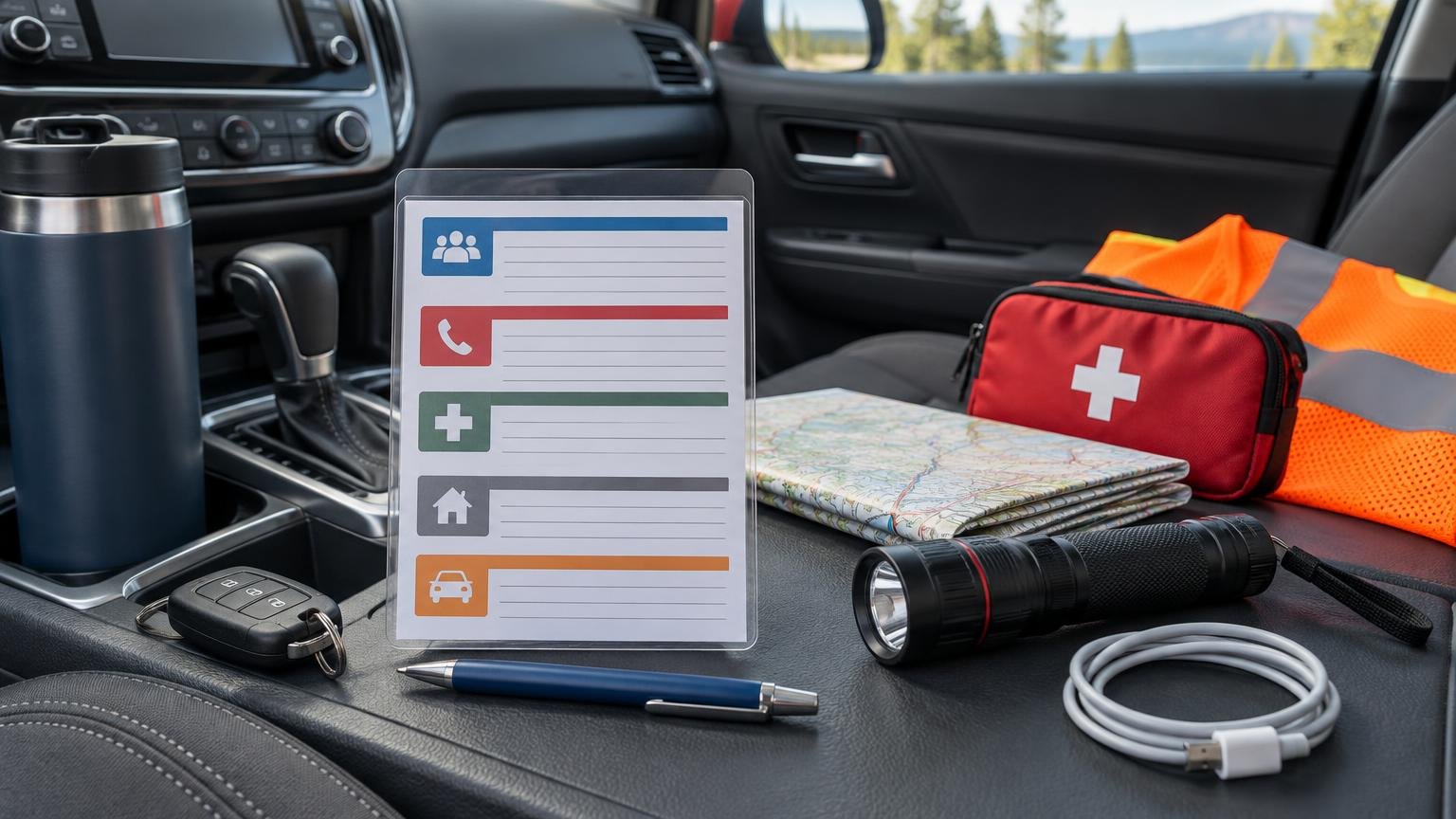
Car Emergency Information Card: Contacts, Medical Details, and Roadside Numbers
TLDR
A car emergency information card should give the driver, passengers, or a trusted helper the few details needed to make a call or handle a roadside delay. Include names, two emergency contacts, immediate medical alerts, roadside-assistance details, locally verified road-condition information, and a last-updated date. Keep highly sensitive records off the card unless their practical value clearly outweighs the privacy risk. Store the card in a labeled, protected location and review it every six months, before long trips, and whenever contacts, medications, insurance, or roadside coverage change.
A car emergency information card is a low-tech backup for moments when a phone is unavailable, its battery is dead, or stress makes familiar information hard to recall. It does not replace 911, a phone’s emergency features, an insurance card, a clinical care plan, or a complete roadside kit. It is primarily a quick reference for occupants and known helpers; do not assume a first responder, tow operator, or passerby will find or use it.
The best card is brief enough to scan quickly but specific enough to prompt the right action. The American Red Cross and Ready.gov offer emergency contact card models, while CDC preparedness guidance supports keeping important contact, medical, pharmacy, insurance, and identification information in a protected portable format.
The five fields to complete today
If you only have five minutes, start with the information most likely to help during a breakdown, delay, or personal emergency:
- Driver and regular passenger names: Add preferred names and, where relevant, the name of a child’s parent or guardian.
- Two emergency contacts: List their names, relationships, and phone numbers. Choose people likely to answer and who know your household’s plans.
- Immediate medical alerts: Record only actionable details, such as a serious allergy, communication need, or critical condition that may affect assistance.
- Roadside provider: Add the dispatch number for your insurer, membership plan, vehicle manufacturer’s active roadside program, or another service you have verified.
- Last updated: Date the card so you can quickly tell whether the information is still dependable.
Tell your emergency contacts that they are listed and confirm their numbers. A card is much less useful if the contact no longer answers that number or does not recognize the driver’s name.
Use a two-level layout
A practical design separates urgent, frequently used information from more private reference details. This makes the card faster to read and reduces the amount of personal data exposed when someone only needs a roadside number.
Side one: Use now
- Driver or household name
- Emergency contact 1: name, relationship, phone
- Emergency contact 2: name, relationship, phone
- Immediate medical or communication alerts
- 911 for an immediate threat to life or safety
- Roadside-assistance dispatch number
- Card location note if additional information is stored separately
- Last-updated date
Side two: Vehicle and trip reference
- Vehicle year, make, model, color, and license plate
- Insurer’s roadside or claims phone number
- Roadside membership number, if you accept the privacy trade-off
- Vehicle manufacturer’s roadside number and coverage expiration, if applicable
- Preferred repair shop or trusted local towing contact
- Clinician and pharmacy phone numbers when relevant
- State or local road-condition service verified for the places you travel
- Space for a temporary trip note: route, destination, expected arrival, and check-in contact
Keep temporary trip notes on a removable slip rather than rewriting the permanent card. Before a longer or remote drive, note the planned route and expected arrival, then share that information directly with a trusted person. Remove the trip slip afterward.
Which medical details belong on the card?
Use the card for information that could change what an occupant or trusted helper does. Avoid turning it into a full medical record. Appropriate entries may include a severe allergy, an important communication or mobility need, a condition requiring a specific response plan, or the location of a separate clinician-approved care document.
For a person with medical, functional, or access needs, CDC preparedness materials support maintaining a medication list that includes the diagnosis, dosage, frequency, medical-supply requirements, and known allergies. That fuller list can be kept in a separate sealed envelope or carried by the person rather than printed on the front of the vehicle card.
Do not place medicines in a vehicle simply because they appear on the card. Vehicle temperatures can vary widely, and storage requirements depend on the medicine. Follow the label and ask a pharmacist how to handle emergency or travel storage for a specific prescription.
Blood type does not need to be a default field. Include it only if a current care plan or qualified clinician has given you a specific reason to record it. Likewise, avoid unexplained abbreviations. Plain language such as “severe peanut allergy” or “uses hearing aids” is more readable than a personal shorthand known only to the family.
Roadside and emergency numbers to personalize
A generic card downloaded from the internet cannot know which services cover your vehicle. Verify every number using your current insurance documents, membership account, manufacturer materials, or the service’s official website.
| Entry | What to record | Important check |
|---|---|---|
| Emergency services | 911 | Use for an immediate threat to life or safety, not routine towing. |
| Roadside plan | Dispatch number and optional member ID | Confirm the plan is active and which vehicle or person it covers. |
| Auto insurer | Roadside or claims number | Distinguish claims service from roadside dispatch. |
| Vehicle program | Manufacturer roadside number | Check eligibility and the coverage expiration date. |
| Tow or repair contact | Trusted local business number | Treat it as a backup; availability and service area can change. |
| Road conditions | Applicable state or local service | 511 availability and features vary, so verify the resource for each region. |
| Poison help | 1-800-222-1222 in the United States | Call 911 if someone collapses, has a seizure, has trouble breathing, or cannot be awakened. |
Poison Control identifies 1-800-222-1222 as the U.S. poison-help line, providing free, confidential expert help around the clock. It directs callers to use 911 for severe symptoms such as collapse, seizure, trouble breathing, or inability to wake the person. Save the official Poison Control assistance guidance and the number in your phone as well as on the card.
Adjust the card for regular passengers
A household card can cover routine roadside needs, but some passengers warrant a separate insert. Keep each insert concise, clearly named, and current.
- Children: Include parent or guardian contacts, another authorized contact, serious allergies, and communication needs. Avoid unnecessary school or schedule information.
- Older adults: Record the preferred contact, mobility or communication needs, and the location of a separate medication list if one is maintained.
- People with support needs: Add plain-language instructions that another occupant can follow, plus the contact responsible for the person’s support plan.
- Pets: List the owner, veterinarian, and an alternate caregiver. Add a brief handling warning only when it is genuinely useful.
- Occasional passengers: Do not collect or retain detailed personal records. Ask them to use their own phone emergency settings or carry a personal card.
Each person should know that the card exists and agree to the information recorded when they can provide consent. Review children’s and dependent passengers’ details as their needs change.
Balance access with privacy
A vehicle is not a secure records vault. It can be lost, sold, borrowed, serviced, or broken into. Use the least sensitive information that still lets the card do its job.
A labeled envelope in the glove compartment or center console is usually easier for occupants to remember than an obscure hiding place. A waterproof sleeve protects against spills and dampness. Tell regular drivers exactly where it is, but do not place private medical or account details in open view.
Consider leaving these items off the basic card: full home address, date of birth, driver’s license number, complete vehicle identification number, full insurance policy number, account passwords, and extensive medical history. A license plate and vehicle description may be sufficient for routine roadside identification. If a roadside provider requires a member or policy number, decide whether convenience justifies storing it in the parked vehicle.
A useful compromise is a layered system: a minimal card in the vehicle, fuller emergency information in a sealed envelope, and current documents in a secure phone or household records system. CDC’s emergency paperwork guidance offers a broader framework for collecting and protecting important information.
Pair the card with the right vehicle kit
Information helps you organize a response, but it cannot provide water, visibility, warmth, shade, power, or tire support. Build the physical kit around the climate, passengers, trip distance, expected roadside wait, and realistic vehicle problems. For a broader starting point, use this car emergency supplies checklist.
NHTSA recommends vehicle emergency supplies such as a phone and charger, first-aid kit, flashlight, warning devices, jumper cables, tire-pressure gauge, jack and ground mat, gloves, water, food, medicines, maps, and warm layers or blankets. Review NHTSA’s road-trip and vehicle-kit guidance before tailoring the list.
- Communication: Charged phone, compatible charging cable, vehicle charger, backup power, and a paper card in case electronics are unavailable.
- Visibility: Flashlight, reflective warning equipment, and other legal signaling items appropriate to your location.
- Tire and battery problems: Vehicle-compatible tire tools and a maintained jump-start option. Compare a portable jump starter with jumper cables based on whether another vehicle is likely to be available.
- Roadside waiting: Water, suitable shelf-stable food, first-aid supplies, needed personal items, and clothing appropriate to the forecast and passengers.
- Passenger needs: Infant supplies, mobility items, sensory or communication aids, safe foods for allergies, and pet restraints or water where applicable.
- Navigation: Paper map for unfamiliar or remote routes, plus written destination and contact details.
Match quantities to the trip rather than treating every drive alike. A short urban errand, a winter highway trip, and a remote multi-hour route create different waiting times and assistance options. Check product labels and replace supplies that are damaged, leaking, expired, or no longer appropriate for the season.
Cold-weather and long-trip additions
Before winter travel, the National Weather Service advises checking forecasts and road conditions and carrying equipment that can include a charged phone and charger, blankets, a flashlight, first-aid supplies, nonperishable food, traction material, a shovel, an ice scraper, and booster cables. Check the National Weather Service winter preparedness graphics for official reminders.
For a longer trip, check the vehicle, weather, route, road conditions, fuel or charging plan, and available roadside coverage before departure. Give a trusted contact your route, destination, expected arrival, and planned check-in time. The card should support that plan, not become the only place where it exists.
Review the card and kit on a schedule
Choose two recurring dates each year—such as the start of summer and winter—to inspect the card and vehicle kit. Also update them immediately after a change in phone numbers, household members, medical needs, pharmacy, insurance, roadside membership, vehicle, or regular travel pattern.
- Call or message listed contacts to confirm their numbers.
- Verify roadside, insurer, manufacturer, and local road-information numbers through official sources.
- Check the last-updated date and replace any hard-to-read card.
- Inspect water, food, first-aid items, batteries, charging equipment, and personal supplies according to their labels and condition.
- Test maintained equipment as its manufacturer directs.
- Remove obsolete trip notes and unneeded personal information.
- Confirm that every regular driver knows where the card and kit are stored.
Make the card today, then test it
Start with a folded index card or a single printed sheet rather than waiting for a perfect design. Fill in the five essential fields, place the card in a protective sleeve, and ask another household member to find the roadside number and first emergency contact. If either takes more than a few seconds to locate, simplify the layout.
A useful car emergency information card is short, readable, current, and connected to a real readiness plan. Once the card is in place, inspect the physical kit, verify the numbers, and put the next review date on the household calendar.
References
- Emergency Contact Card
- Emergency Kit Checklist: Pregnant Women, Infants, and Children | Children & School Preparedness | CDC
- Paperwork | Prepare Your Health | CDC
- Write your family’s name above
- cdc.gov
- Need immediate assistance? | Poison Control
- Summer Driving & Road Trip Tips | NHTSA
- Winter Infographics

