
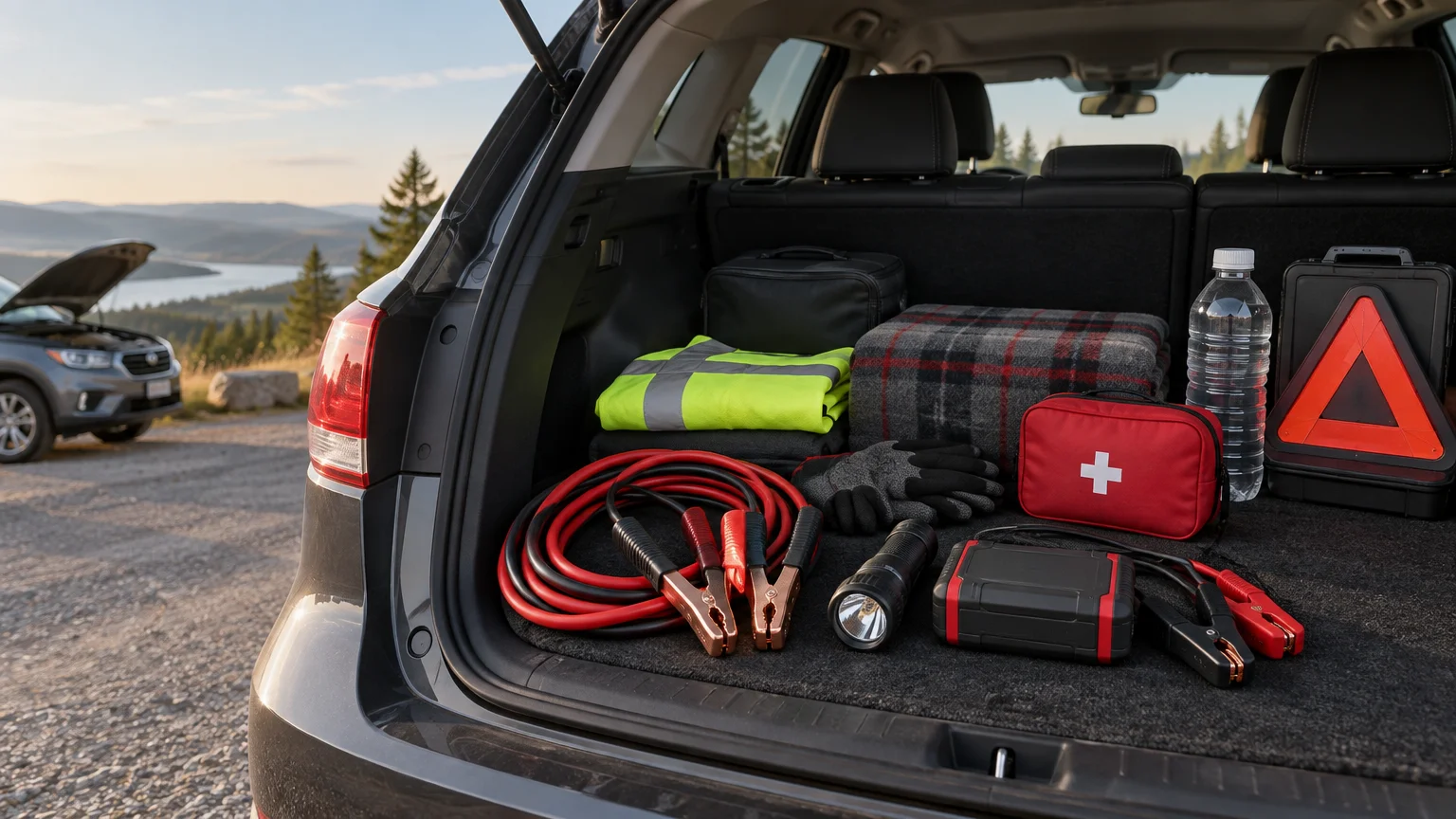
TLDR: In a jump starter vs jumper cables emergency decision, a portable jump starter is usually the more self-sufficient choice because it does not require another vehicle. Jumper cables are simpler and useful when a suitable donor vehicle is likely to be available. Carrying both provides the most flexibility if you drive alone, travel on rural routes, face severe weather, or cannot count on quick roadside assistance.
Neither option is a complete roadside plan. A jump can help when a discharged 12-volt battery is the problem, but it cannot fix every no-start condition. Your emergency car kit should also support communication, visibility, water, weather protection, tire trouble and a potentially long wait for help.
The practical difference between a jump starter and jumper cables
Jumper cables transfer power from an appropriate donor source, normally another vehicle. Without that donor, the cables cannot start your car. A portable jump starter stores its own power and uses attached or removable clamp leads, allowing a driver to attempt a start without another car.
| Option | Main advantage | Main limitation | Best fit |
|---|---|---|---|
| Jumper cables | Simple equipment with no internal battery to recharge | Requires an appropriate donor vehicle and safe access between vehicles | Urban or well-traveled driving where help is likely |
| Portable jump starter | Can support a self-recovery attempt without another vehicle | Must be charged, stored correctly and suitable for the vehicle | Solo driving, remote routes and situations where outside help may be delayed |
| Both | Provides independent power plus a backup method | Takes more space and requires maintenance of the jump pack | Drivers seeking the most flexible emergency setup |
This makes a portable pack the stronger primary tool when independence matters. It is not automatically the right device for every vehicle, however. The pack must be appropriate for the vehicle and used according to both the pack instructions and vehicle manual. AAA identifies vehicle-appropriate power, protective features such as reverse-polarity or spark protection, and warranty support as relevant considerations when selecting a pack.
When jumper cables may be enough
Cables can be a reasonable basic choice when most of your driving is in populated areas, another suitable vehicle is likely to be nearby, and roadside help is readily available. They also avoid the problem of discovering that a stored jump pack has lost its charge.
Choose cables that can be stored without crushing or damaging their clamps and insulation. Keep them accessible rather than buried under luggage. Before using them, consult the vehicle manual for the specified connection points, sequence and restrictions. Do not assume a familiar procedure applies to every vehicle.
Cables are less reassuring on isolated roads, at quiet trailheads, during late-night travel or anywhere asking a stranger for a jump could create an additional risk. They also require enough physical access to position the donor source as directed. If those conditions regularly describe your travel, donor-dependent equipment should not be your only battery plan.
When a portable jump starter earns its place
A portable jump starter is most useful when you need a realistic chance of handling a discharged battery without waiting for a second vehicle. That includes solo commuting at unusual hours, rural travel, winter driving and trips where passengers could be especially affected by a long delay.
The tradeoff is maintenance. A pack that is discharged when needed is simply stored weight. Follow its manufacturer’s charging and inspection instructions rather than relying on a universal recharge schedule. Check its status before long trips and as part of a recurring vehicle-kit review.
If the unit contains a lithium-ion battery, storage temperature deserves attention. The U.S. Fire Administration advises keeping lithium-ion batteries at room temperature where possible, away from direct sunlight and hot cars. It also advises against charging them outside 32–105°F, with the manufacturer’s instructions governing the particular product. USFA battery fire-safety guidance This creates a practical challenge for equipment intended for a vehicle: do not leave the pack forgotten through months of extreme cabin temperatures. Store and rotate it according to its instructions, and inspect it before returning it to service.
Remove a pack from use if it is damaged or otherwise fails the manufacturer’s inspection criteria. Do not improvise repairs or treat a swollen, cracked or compromised battery pack as normal roadside equipment.
Who should consider carrying both?
Carrying both makes sense when the consequences of a dead battery are greater than the inconvenience of a little extra storage space. The combination gives you an independent first option and donor-assisted backup if the pack is unavailable or not ready.
- Solo drivers who cannot depend on another person being present
- People who regularly use rural roads or routes with unreliable cellular coverage
- Families traveling with children, older adults or anyone with temperature-sensitive needs
- Drivers facing severe winter cold or extreme summer heat
- Travelers taking long road trips far from familiar service locations
- Anyone whose work schedule puts them on the road late at night or before normal business hours
For short trips through busy areas, carrying both may be unnecessary if roadside support is dependable and a delay would be manageable. The decision should reflect the likely stranding, not the size of the equipment collection you can fit in the trunk.
A jump attempt cannot solve every no-start problem
A jump starter and cables address one narrow situation: a vehicle that may start with outside 12-volt power. An unsuccessful attempt can indicate another problem, including the starter, alternator, a fuse, a battery cell or another electrical fault. Repeated attempts are not a substitute for diagnosis.
If the vehicle still will not start after you have followed the correct procedure, shift from recovery to roadside safety. Make occupants visible and protected from weather, preserve phone power, communicate your location clearly and arrange appropriate assistance. If the vehicle starts but shows warning lights or behaves abnormally, follow the manual and seek service rather than assuming the underlying problem has disappeared.
Hybrid and EV owners must check the vehicle manual
Electrified vehicles can still have a 12-volt system, but their connection points and restrictions are vehicle-specific. Do not infer the correct procedure from a conventional gasoline vehicle or from another hybrid.
For example, Toyota’s 2025 Grand Highlander Hybrid instructions identify designated connection points and state that its exclusive jump terminal cannot be used to jump-start another vehicle. That is one model-specific example, not a rule for every hybrid or EV. Find the instructions for your exact model before an emergency, identify any designated terminals and keep the manual available.
Build the rest of the kit for a roadside wait
Battery-recovery equipment may shorten a stranding, but your kit also needs to support the period before recovery or assistance. NHTSA includes jumper cables, a phone and charger, a flashlight, signaling equipment, water, food, basic tools, tire supplies, maps, and blankets or warm clothing in its recommended roadside emergency supplies. NHTSA’s road-trip and emergency-kit guidance
Use that foundation to build a kit around your passengers, climate and usual routes. A practical starting checklist includes:
- Communication: a charged phone, compatible charging cable, vehicle charger and written roadside-assistance details
- Visibility: a flashlight and suitable roadside signaling equipment stored where it can be reached safely
- Water and food: enough for the likely occupants and delay, with regular checks for leaks, spoilage or heat damage
- Weather protection: seasonal clothing, blankets, rain protection, sunscreen or shade measures as conditions require
- Tire readiness: the vehicle’s supplied tire equipment, an appropriate pressure gauge and knowledge of how your particular repair or spare system works
- Navigation: an offline map or paper map for routes where service may disappear
- Basic information: emergency contacts, medical considerations and the vehicle’s location-sharing method
- Battery recovery: inspected cables, a ready jump pack or both, plus the applicable instructions
For a more complete packing framework, use this emergency car supply checklist. If vehicle charging is part of a wider household resilience plan, a separate emergency phone charging plan can help you reserve limited power for essential communication.
Adjust the kit for climate and trip distance
Cold-weather driving
Cold-weather preparation should extend beyond battery equipment. National Weather Service guidance recommends checking the battery, tires, wipers and coolant, while carrying items such as blankets, food, water, traction material, a shovel, an ice scraper or brush, communication supplies and booster cables. Add or remove seasonal equipment as conditions change instead of carrying last winter’s kit untouched all year.
Hot-weather driving
Heat affects both people and stored supplies. Check water containers, food, medications and battery-powered equipment for storage limitations. A lithium-ion jump pack requires particular attention because a closed vehicle can conflict with guidance to avoid hot-car storage. Follow the device instructions and use a routine that keeps the pack available without abandoning it in damaging conditions.
Long-distance and rural routes
Distance changes the value of self-recovery and the amount of waiting support you need. Before leaving, tell someone your route and expected arrival, identify stretches with weak cellular coverage, check fuel or charge, and consider how long assistance could realistically take. Carry enough water and weather protection for all occupants, not just the driver.
Use a simple inspection and rotation routine
An emergency car kit should be a maintained system, not a box sealed once and forgotten. Review it when seasons change and before long trips.
- Check the portable starter’s charge and inspect its case, cables and clamps according to its instructions.
- Inspect jumper cables for damaged insulation, contamination, corrosion or compromised clamps.
- Confirm that charging cables still match the phones carried by regular passengers.
- Rotate water, food, medications and other dated or temperature-sensitive supplies.
- Replace seasonal clothing and weather gear as temperatures change.
- Verify tire pressure and confirm that the vehicle’s tire tools or repair system remain complete.
- Update emergency contacts, roadside-assistance information and any printed route details.
- Read the vehicle’s jump-start section again if the vehicle is new, recently replaced or unfamiliar.
The best choice for most emergency kits
Choose a portable jump starter if independent recovery is the priority and you are willing to maintain it. Choose jumper cables if you expect reliable access to an appropriate donor vehicle and want simple backup equipment. Carry both when you drive alone, travel far from help, face harsh weather or transport passengers for whom a long roadside wait creates added risk.
Before your next trip, confirm the correct procedure for your vehicle, inspect the chosen battery equipment and add the supplies needed to wait safely if the jump does not work. The best emergency kit does not assume every problem can be fixed beside the road; it helps you attempt a suitable recovery and remain organized when professional assistance is still necessary.