
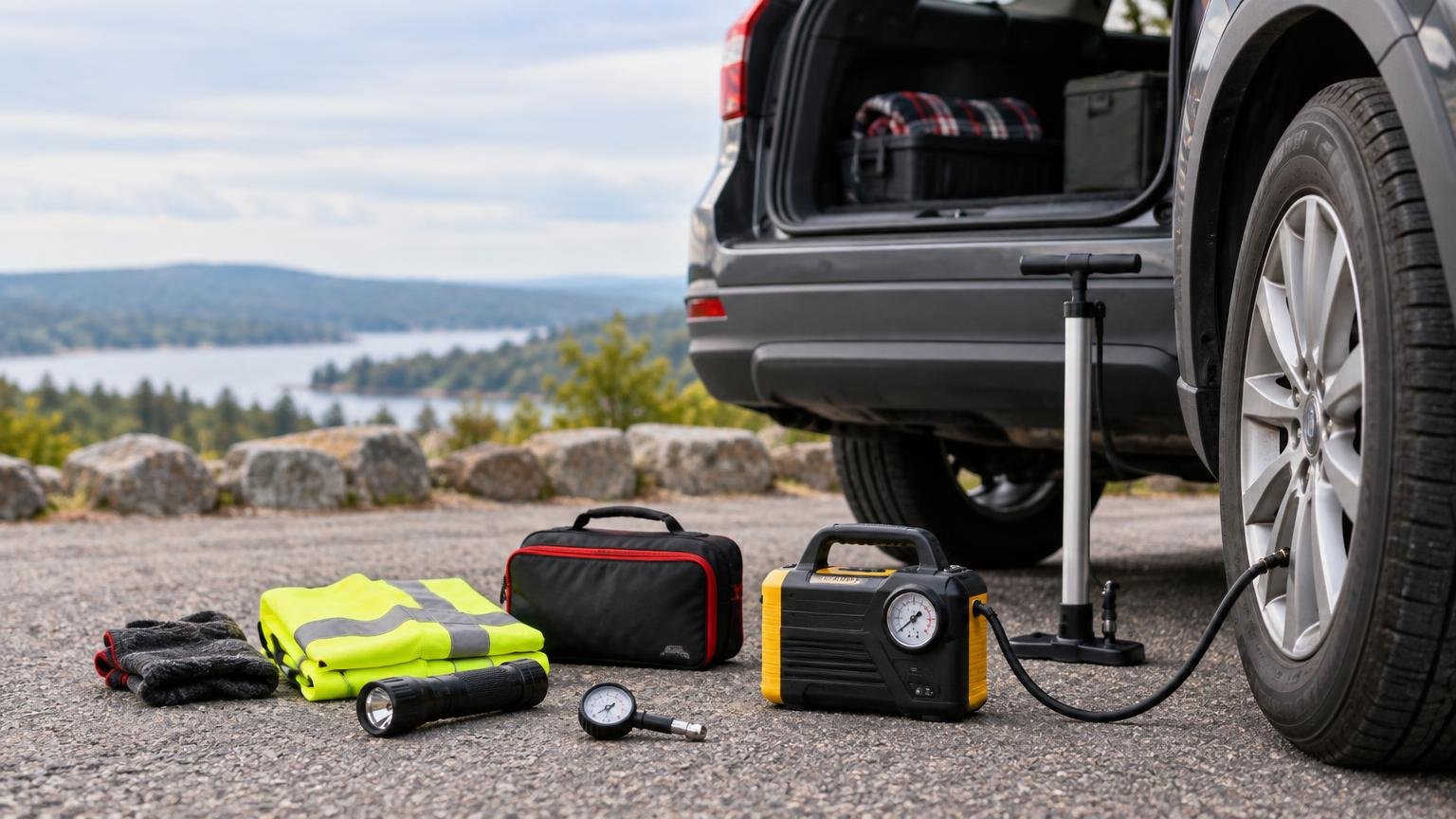
Portable Tire Inflator vs Manual Pump for Roadside Preparedness
For most drivers, a portable electric tire inflator is the better primary roadside tool. It requires less physical effort, and some models offer pressure presets and automatic shutoff. A compatible manual pump remains valuable as a power-independent backup, especially on remote trips or when a vehicle battery or rechargeable inflator battery may be unavailable.
Neither tool repairs serious tire damage. An inflator or pump can restore missing air when the tire is still safe to inflate, but it cannot diagnose the leak, repair a damaged sidewall, or make a tire driven while flat safe again. Your complete plan should also account for a spare tire or vehicle-supplied repair kit, roadside assistance, visibility, communication, weather, passengers, and the possibility of waiting beside the road.
The practical differences at a glance
| Factor | Portable electric inflator | Manual pump |
|---|---|---|
| Physical effort | Usually lower; the motor performs the compression work | Higher; requires repeated hand or foot operation |
| Power requirement | May use a 12-volt outlet, internal battery, or another model-specific source | Human-powered and independent of vehicle electricity |
| Pressure control | May include a digital gauge, preset, and automatic shutoff | Needs a dependable integrated or separate pressure gauge |
| Maintenance | Check the cord, hose, connector, battery, and operating instructions | Inspect the hose, seals, base, handle, and gauge |
| Best role | Primary tool for most ordinary roadside kits | Backup tool or primary option when electrical independence is the priority |
| Main limitation | Power compatibility, battery condition, and duty-cycle limits vary by model | Inflating a car tire can require substantial time and effort |
There is no universal performance winner across every product. Inflation speed, maximum pressure, gauge accuracy, connector design, battery life, automatic shutoff, and allowed operating time must be checked for the exact model. A feature advertised on one inflator should not be treated as standard across the category.
Why an electric inflator is usually the better primary choice
A roadside tire problem may happen in rain, darkness, extreme heat, freezing weather, or a location where you want to minimize time outside the vehicle. Reducing physical work is useful under those conditions. An electric inflator can also be easier for a driver with limited strength, mobility restrictions, or an injury.
Pressure presets and automatic shutoff, where provided, can simplify the process. Even then, the driver must enter the correct target and confirm the result with a suitable gauge. The correct pressure is the vehicle manufacturer’s specification on the driver-side door placard or in the owner’s manual—not the maximum pressure molded into the tire sidewall. NHTSA advises checking tires cold, including the spare, monthly and before long trips. NHTSA’s TireWise guidance explains the pressure and maintenance basics.
Before buying an inflator, identify how it receives power. A 12-volt model depends on a compatible, working vehicle outlet and may have instructions about whether the engine should be running. A cordless model depends on a charged battery. Some units support more than one source, but power options and operating limits are model-specific. Read the manual before placing the tool in the trunk rather than trying to decode it during a breakdown.
When a manual pump earns its place
A manual pump’s main advantage is simple: it does not depend on the car’s electrical system or a charged battery. That makes it a sensible backup for long-distance travel, remote routes, cold-weather driving, or any kit built with redundancy in mind.
The tradeoff is effort. Adding a small amount of air is different from trying to recover a substantially underinflated car tire. Pump design, tire size, starting pressure, temperature, and the operator’s strength all affect how demanding the job becomes. If a manual pump is your primary tool, test it at home on the vehicle before relying on it. Confirm that its connector fits securely, the hose reaches comfortably, and its gauge is readable and credible. If the integrated gauge is poor or absent, carry a separate tire-pressure gauge.
That home test should be controlled and uneventful: use a sound tire that only needs a modest adjustment, follow the pump instructions, and stop at the placard pressure. The objective is to learn how the connector and gauge work—not to stage a simulated emergency or deliberately deflate a tire.
Know when inflation is not the answer
A tire-pressure monitoring system warning deserves prompt attention. NHTSA advises stopping and checking the tires as soon as possible because continued driving on a significantly underinflated tire can generate heat, contribute to failure, and impair handling and stopping.
Do not assume that every low or flat tire should be reinflated. Visible sidewall damage, a tire displaced from the rim, severe deformation, smoke, unusual heat, or damage caused by driving while deflated calls for professional help rather than roadside experimentation. Michelin also warns that an exterior plug alone, without removing and inspecting the tire internally, is not a reliable complete repair; puncture location, size, sidewall condition, and prior operation while deflated all matter.
Check what your vehicle already provides
Do not build the plan around a spare tire you have never seen. Many newer vehicles omit a conventional spare and may provide a sealant-and-compressor kit instead. Check the cargo area and owner’s manual, identify every component, and learn the manufacturer’s procedure. If there is a spare, confirm that the jack and tools are present and check the spare’s pressure before long trips.
Vehicle-supplied sealant kits have limitations and expiration dates. They may not work for every puncture or damage pattern, so review the instructions before an incident and record the replacement date with your other vehicle-maintenance reminders. A separate inflator can still be useful, but it does not erase the limitations of the supplied repair system.
How to choose the right setup for your trips
For ordinary commuting and paved-road travel, start with a dependable electric inflator that matches the vehicle’s power options. Add a separate pressure gauge if you are not confident in the built-in one. Drivers taking remote routes, traveling in severe cold, or spending long periods away from services should consider adding a sturdy manual pump as a backup rather than replacing the electric unit.
Evaluate the setup around the circumstances in which it must work:
- Power: Verify the inflator’s required outlet, plug, battery platform, charging method, cord reach, and instructions.
- Tire compatibility: Check the required pressure range, connector type, hose reach, and whether the unit is intended for your vehicle’s tire size.
- Operating limits: Read the duty-cycle and cooling instructions so the motor is not run longer than the manufacturer permits.
- Pressure measurement: Keep the door-placard specification accessible and carry a separate gauge when appropriate.
- Physical ability: Choose equipment that the intended driver can connect, operate, and pack away without assistance.
- Trip exposure: Add more redundancy for remote roads, long distances, severe temperatures, limited cellular coverage, or travel with vulnerable passengers.
A tire tool is only one part of a useful road trip emergency kit. AAA and the Red Cross include portable inflators or tire repair and inflation equipment among recommended vehicle supplies, but they place those tools alongside communication, visibility, food, water, lighting, and other essentials.
Build the rest of the kit around waiting safely
A compressor may solve a minor pressure problem in minutes, but a damaged tire, dead battery, collision, road closure, or severe storm can leave you waiting much longer. Pack for the people and conditions in the vehicle, not just the mechanical fault.
Carry a charged phone, vehicle charger or power bank, flashlight, emergency contact details, water, and nonperishable snacks. Account for children, older adults, medical needs, and pets. The American Red Cross car emergency kit guidance provides a useful foundation, while a concise car emergency information card can keep roadside numbers and essential contacts available if a phone is dead or locked.
Adapt that foundation to the climate. Hot-weather travel calls for additional water, sun protection, shade, and cooling supplies. Winter travel may require blankets, warm clothing, gloves, boots, an ice scraper, a shovel, and traction materials. Ready.gov’s winter car-kit checklist offers a practical cold-weather reference.
Mechanical redundancy should cover more than tires. Decide whether your battery plan uses jumper cables, a portable jump starter, or both; the right choice depends on access to another vehicle, climate, trip distance, and your willingness to maintain a charged device. This jump starter versus jumper cables comparison applies the same primary-tool-and-backup logic used for tire equipment.
Inspect the kit before it becomes an emergency
Review the vehicle kit seasonally and before long trips. Check the inflator’s power cord, plug, hose, connector, and battery charge. Operate it according to its instructions so you know it still works. Inspect the manual pump for cracked hoses, loose fittings, damaged seals, or an unstable base. Compare each gauge with another dependable gauge if its readings seem questionable.
Also check the spare-tire pressure, sealant or repair-kit expiration date, flashlight batteries, power banks, water, food, medications, clothing, and passenger-specific supplies. Rotate anything affected by age or temperature. AAA and Red Cross guidance supports reviewing kits regularly and adapting them to passengers, season, and travel conditions.
The best roadside arrangement
Choose a portable electric inflator as the primary tool for most cars, provided it is compatible with the vehicle and the driver knows how to operate it. Add a manual pump when power independence and redundancy justify the space and effort. Carry a dependable pressure gauge either way.
Most importantly, treat inflation equipment as one branch of the plan—not the whole plan. Know the vehicle’s specified tire pressure, understand its spare or repair system, recognize damage that should not be reinflated, and carry the communication, visibility, water, food, and weather protection needed to wait safely. The most useful roadside kit is the one matched to the vehicle, route, climate, and actual passengers, then checked often enough that every part works when needed.
Frequently Asked Questions
Is a portable tire inflator or manual pump better for a car emergency?
A compatible electric inflator is usually the better primary tool because it requires less physical effort. A manual pump is most useful as a backup when vehicle power or a charged battery may be unavailable.
Can a manual pump inflate a car tire?
A compatible manual pump can add air, but a substantially underinflated car tire may require considerable time and effort. Test the pump at home on a sound tire that needs only a modest adjustment before relying on it roadside.
Does every portable inflator have automatic shutoff?
No. Presets and automatic shutoff are model-specific features, as are inflation speed, battery life, maximum pressure, and operating limits. Check the exact product rather than assuming those features are standard.
What tire pressure should I enter into an inflator?
Use the vehicle manufacturer’s specification on the driver-side door placard or in the owner’s manual. Do not use the maximum pressure molded into the tire sidewall as the target.
Do I need a separate tire-pressure gauge?
Carry one if the inflator or manual pump lacks a suitable, dependable gauge. Pressure control requires comparing the current reading with the vehicle specification and adding only the missing air.
Can an inflator make a damaged tire safe to drive on?
No. It can restore pressure, but it cannot diagnose a leak, repair sidewall damage, or make a tire driven while flat safe again. Serious damage requires professional assessment.
What should I do when the tire-pressure warning light comes on?
Stop and check the tires as soon as it is safe. Continued driving on a significantly underinflated tire can generate heat, contribute to failure, and impair handling and stopping.
Should I assume my vehicle has a spare tire?
No. Many newer vehicles omit a conventional spare and may provide a sealant-and-compressor kit instead. Check the cargo area and owner’s manual, then confirm that every supplied component is present and usable.
How often should I inspect roadside tire equipment?
Review it seasonally and before long trips. Check cords, plugs, hoses, connectors, battery charge, pump seals, gauges, spare pressure, and repair-kit expiration dates, then rotate other age- or temperature-sensitive supplies.
What belongs in the vehicle kit besides tire equipment?
Carry communication, lighting, visibility, water, food, charging, emergency-contact, and climate-appropriate supplies. Adjust the kit for trip distance, weather, children, older adults, medical needs, pets, and the possibility of a long roadside wait.
References
- Flat and Damage Problems : Symptom Damage that Requires Repair | Michelin USA
- Instruction Manual
- AAA.com | AAA Digital Preset Air Inflator
- Summer Driving & Road Trip Tips | NHTSA
- Tire Safety Ratings and Awareness | TireWise | NHTSA
- What to do in an emergency
- How To Change a Tire in 11 Easy Steps | AAA Automotive
- Emergency Car Kit: 10 Essential Items | Red Cross
- Tire Inflator Kit Fact Sheet
- How to Prepare Your Car for Roadside Emergencies
- Hurricane Supply List | Red Cross
- IntroductionTable of ContentsWinter storms can bring extreme cold, freezing rain, ice, snow,
- Fourth of July Driving Safety | Press Release | American Red Cross


