
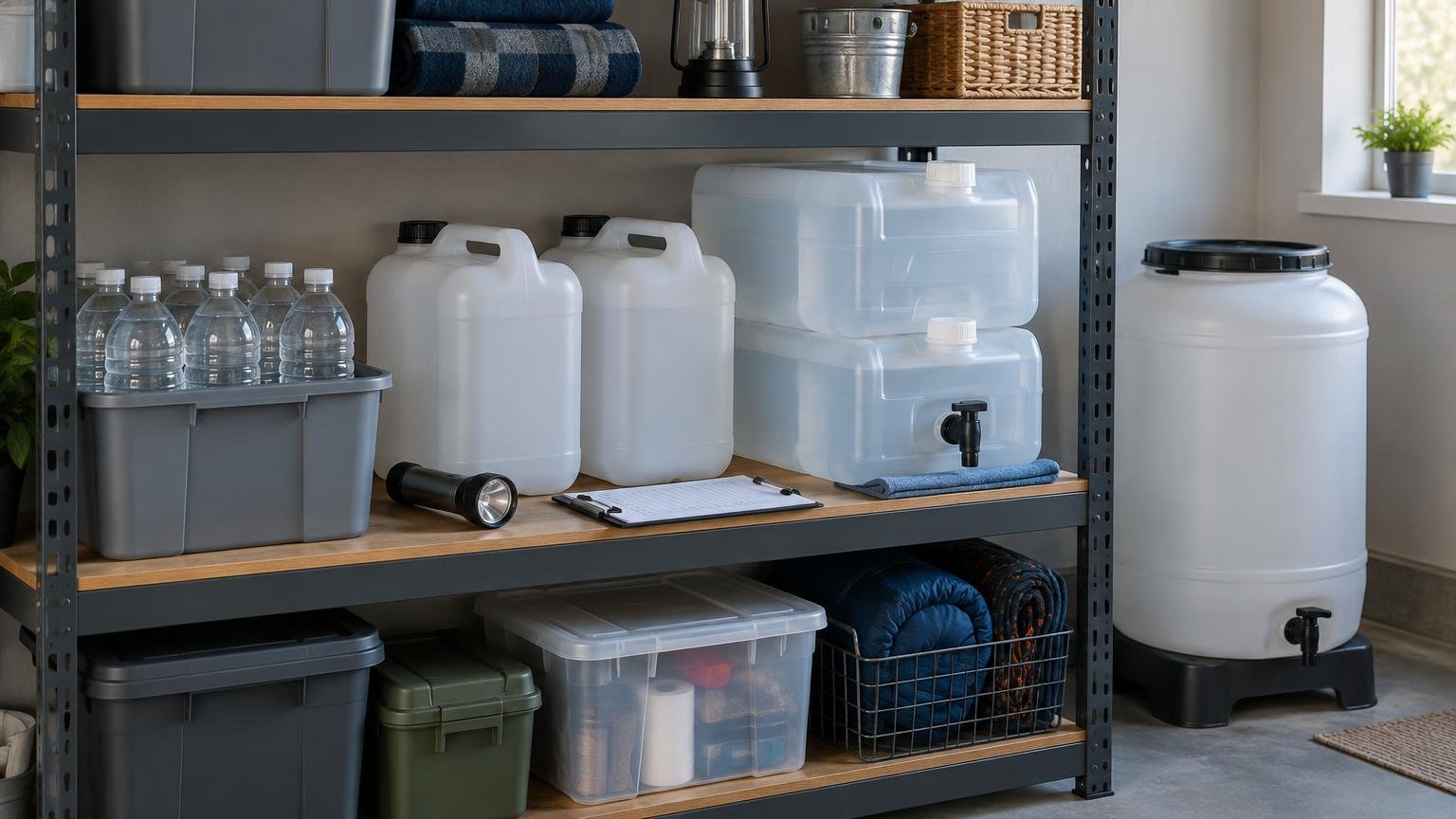
Best Containers for Storing Emergency Water at Home
TLDR
The most practical emergency-water system uses more than one container format. Keep unopened commercially bottled water or manageable portable containers for immediate use and evacuation, then add larger refillable potable-water containers if you have suitable storage space. Choose each container according to its intended use, filled weight, closure, dispensing method and storage conditions. Avoid any container that previously held bleach, pesticides or other toxic chemicals.
If you are searching for best containers emergency water storage options, do not look for one universal winner. A five-gallon jug, small bottle and large stationary tank solve different problems. Start by calculating how much your household needs, then divide that supply among containers every household member can safely access and use.
How much emergency water should you store?
The CDC recommends storing at least one gallon per person per day for drinking and basic sanitation. It advises keeping at least a three-day supply and trying for a two-week supply when possible. Pregnancy, illness, pets and hot conditions can increase the requirement. The CDC emergency-water guide provides the official planning and storage guidance. Ready.gov uses the same one-gallon baseline and distinguishes between supplies stored at home and supplies that can travel during an evacuation.
Use this starting calculation: number of people × number of days × one gallon. Then add water for pets and household members with additional needs. Consider water-dependent food preparation as well. If your emergency menu contains dehydrated meals, powdered drinks or infant formula, that preparation water must come from the same limited supply. Households managing allergies or medical diets should coordinate water planning with their emergency food plan for special diets.
| Household plan | Baseline volume | Water weight | Practical implication |
|---|---|---|---|
| 2 people for 3 days | 6 gallons | About 50 pounds | Easy to divide among bottles or two small containers |
| 4 people for 3 days | 12 gallons | About 100 pounds | Use several portable containers rather than one vessel |
| 4 people for 14 days | 56 gallons | About 466 pounds | Requires planned home storage plus a separate portable supply |
These weights exclude the containers themselves. A gallon of water weighs about 8.33 pounds, so container size quickly becomes a handling issue. A nominally portable container is not useful if the person who needs it cannot lift, carry or control it while pouring.
How to choose the best containers for emergency water storage
The best format is the one that performs a defined job without creating an access or contamination problem. For most households, that means combining two or three of the following formats rather than committing the entire supply to one large vessel.
Unopened commercially bottled water
The CDC identifies unopened commercially bottled water as the safest and most reliable emergency water source. It is convenient for immediate drinking, portion control and evacuation. Smaller bottles are easy to distribute, while larger retail jugs reduce the number of individual packages.
The tradeoff is storage efficiency. Small bottles create more individual items to inspect and rotate, and thin retail packaging may be less convenient for repeated handling. Follow the product label and manufacturer’s storage instructions rather than assuming one universal shelf life applies to every bottled-water product.
Small refillable containers
Small potable-water containers are suitable for apartments, evacuation supplies and households in which lifting ability is limited. They can fit on a closet floor or low shelf and make it easier to move part of the supply without disturbing the rest.
Their disadvantages are repeated filling, labeling and rotation tasks. More containers also mean more lids and openings to manage. Choose a consistent size and closure style where possible so the household does not need several special tools during an outage.
Medium jugs and stackable containers
Medium containers often provide the best balance between space efficiency and portability. Before buying one, calculate its filled weight and test whether the intended users can control that weight. A five-gallon container holds more than 41 pounds of water before accounting for the vessel, lid or spigot.
Stackability should be based on the manufacturer’s instructions, not appearance alone. Check whether the product is designed to be stacked when full, how high it may be stacked and whether water can be dispensed in that position. A container that must be lifted onto a counter every time it is used may be impractical during illness, injury or a power outage.
Large barrels and stationary tanks
A large vessel can hold an extended home supply in a compact footprint, but it should be treated as stationary. Before filling it, decide where it will remain, how it will be filled, how water will be dispensed and whether the location can accommodate the full weight. Also consider whether leaks could damage belongings or block an exit.
Large storage does not replace portable water. If an evacuation order arrives, a full barrel will stay behind. Keep a separate supply that can be loaded quickly alongside your family emergency kit.
What to check before buying a water container
Labels such as “food-grade” and “BPA-free” can provide useful information, but neither phrase answers every practical question. FDA oversight of food-contact substances is tied to intended conditions of use; it should not be described as blanket approval of every finished container for every temperature, duration, lid or fitting. Ask the seller or manufacturer for documentation covering the complete product and your intended potable-water use.
- Intended use: The manufacturer identifies the complete container, lid, gasket, spigot and other water-contact components as suitable for drinking-water or relevant food-contact use.
- Secure closure: The lid closes tightly and can be opened without improvised tools. The CDC prefers a narrow opening for pouring when possible.
- Durability: The container can tolerate expected handling without relying on a fragile closure or exposed fitting.
- Manageable weight: A household member can move or dispense from it safely when full.
- Controlled dispensing: Water can be poured or drawn without putting hands, cups or dirty equipment inside the stored supply.
- Storage fit: The container fits its location while leaving access to inspect it for leaks, damage or contamination.
- Clear instructions: Filling, cleaning, sanitizing, stacking, storage and temperature guidance is available from the manufacturer.
- Labeling space: There is room to mark the contents and fill or rotation date clearly.
A reference to NSF should identify both the exact item and the exact standard. For example, NSF maintains listings for particular tanks or components under NSF/ANSI/CAN 61, but a certified component does not automatically establish that every hose, lid, pump and fitting in a storage setup has the same listing. Search the NSF drinking-water component listings when a seller makes a specific certification claim.
Where to store emergency water at home
The CDC advises keeping stored water in a cool place away from direct sunlight and toxic substances, with 50–70°F identified as the preferred range when feasible. A climate-controlled interior closet or pantry floor may therefore be preferable to an attic, hot vehicle or location exposed to chemicals.
Actual conditions matter more than the name of the room. A garage may become very hot or freeze; a basement may be cool but vulnerable to flooding; an outdoor shed may have heat, pests or limited access after a storm. Evaluate the location throughout the year rather than only on the day the containers are filled.
- Keep water away from gasoline, pesticides, cleaners and other toxic substances.
- Place heavy containers low enough to avoid dangerous lifting, but where they remain accessible.
- Protect containers from direct sunlight and temperature extremes.
- Do not position the entire supply where one leak, flood or blocked doorway could make all of it inaccessible.
- Split some water between locations when local hazards make that sensible.
- Never use a container that previously held toxic chemicals, including bleach or pesticides.
How to fill, label and rotate household-stored water
For water you fill yourself, use a food-grade water-storage container when possible. The CDC says an alternative should close tightly, be durable and unbreakable, and preferably have a narrow pouring opening. Follow the CDC’s current cleaning and sanitizing directions and the container manufacturer’s instructions rather than improvising chemical concentrations.
- Inspect the container, closure and dispensing parts for damage.
- Clean and sanitize the container according to current public-health and manufacturer directions.
- Fill it without touching the inside of the container or lid.
- Close it tightly and label it “drinking water” with the storage date.
- Move it to its planned cool, shaded location away from toxic substances.
- For household-filled water, schedule replacement in six months, as advised by the CDC.
- During use, avoid touching the water or inside surfaces. If a scoop or dispensing device is necessary, keep it clean.
Add the rotation date to the same calendar used to review medications, batteries and the rest of your 72-hour emergency kit. If replacing an entire two-week supply at once feels unmanageable, divide it into batches and rotate one batch at a time while ensuring none exceeds your chosen schedule.
Keep evacuation water separate from home reserves
Shelter-in-place storage and evacuation water should overlap, but they are not identical. Home reserves can include medium and large containers. Evacuation water must fit the vehicle or go-bag, remain manageable and leave room for people, medications, documents, food and other necessities.
Keep an accessible portable layer sized for the household’s likely departure plan. Do not bury it behind a stationary barrel or distribute all water among containers too heavy to load. If cost is the obstacle, water storage can be added in stages as part of a month-by-month emergency-kit plan.
A simple household water-storage worksheet
Write down the plan rather than relying on memory. A short inventory makes gaps visible and gives everyone in the household the same instructions.
- People: _
- Planning period: _ days
- Baseline: people × days × 1 gallon = _ gallons
- Additional amount for pets, pregnancy, illness, heat or special food preparation: _ gallons
- Portable evacuation supply: _ gallons in _ containers
- Home reserve: _ gallons in _ containers
- Storage locations: _
- Heaviest filled container: _ pounds
- Can intended users safely move or dispense from it? Yes / No
- Cleaning or inspection date: _
- Next rotation date for household-filled water: _
What to do during a water advisory
Stored water is a preparedness resource, not a substitute for official instructions. If authorities say tap water is unsafe after an emergency, use bottled, boiled or appropriately treated water as directed and follow local health-department guidance. A boil-water notice, do-not-drink notice and do-not-use notice can require different actions, so read the exact advisory rather than assuming one treatment method solves every problem.
The practical choice
For most households, the best plan is layered: sealed portable water for immediate use and evacuation, plus refillable containers sized for the available home storage area and the household’s lifting ability. Calculate the required volume first, make the weight visible, and verify the intended use of every container and component.
Start with a three-day supply you can safely store and access. Then work toward two weeks if space and circumstances allow. Label household-filled water, rotate it on schedule, keep it away from heat, sunlight and chemicals, and make sure at least part of the supply can leave with you.
References
- How to Create an Emergency Water Supply | Water, Sanitation, and Hygiene (WASH)-related Emergencies and Outbreaks | CDC
- Build A Kit | Ready.gov
- Facts About Water | U.S. Geological Survey
- Understanding How the FDA Regulates Substances that Come into Contact with Food | FDA
- Listing Category Search Page | NSF International
- How to Make Water Safe in an Emergency | Water, Sanitation, and Hygiene (WASH)-related Emergencies and Outbreaks | CDC
