What to Do If You Get Turned Around on a Hiking Trail
TLDR
If you realize you are off route, stop before uncertainty becomes a larger emergency. Keep the group together, assess injuries and immediate hazards, and try to establish your location with a map, compass, GPS, offline map, landmarks, and your last known point. Retrace your steps only when the route is known and safe. If you cannot confidently recover the trail, contact emergency services and remain in a safe, visible place unless an immediate threat requires you to move. Conserve energy and phone power, protect yourself from the weather, and use repeated signals to make yourself easier to find.
The safest answer to “what to do if lost on hiking trail” is not to keep walking until something looks familiar. Unplanned movement can increase the search area, separate a group, use up daylight, and lead into steeper or more hazardous terrain. Your first goal is to stop the situation from getting worse; your second is to determine whether a conservative self-rescue is genuinely safe.
The National Park Service’s outdoor emergency plan recommends pausing to assess the situation, establishing your location with available navigation tools or landmarks, and retracing your route only when doing so is safe. If you cannot safely retrace the route, its guidance is to call 911 and stay put unless there is an immediate threat to life.
What to do in the first few minutes
Stop as soon as you suspect you are no longer on the intended trail. Do not wait for absolute proof. A short pause at the first doubtful junction is easier to solve than a long detour made while hoping the route will become obvious.
- Stop moving and keep everyone together. Call out immediately if members of the group have begun spreading out, but do not send people in different directions to scout.
- Slow your breathing and make deliberate decisions. Panic encourages rushed movement and makes it harder to remember recent landmarks or turns.
- Check for injuries, illness, exhaustion, heat symptoms, and urgent medical needs.
- Assess immediate surroundings for hazards such as unstable ground, rising water, severe weather, falling branches, traffic, or exposed terrain.
- Check the time, remaining daylight, weather, clothing, water, food, phone battery, lights, and navigation equipment.
- Identify your last known point: a signed junction, bridge, viewpoint, campsite, road crossing, stream crossing, or distinctive bend in the trail.
Write down the time and your current coordinates if a device provides them. Take a screenshot or photograph of the coordinate display so you do not have to keep the navigation app open. If you eventually move, leave a note or digital record of when, why, and in which direction you went, provided doing so does not delay an urgent response.
Locate yourself before deciding to move
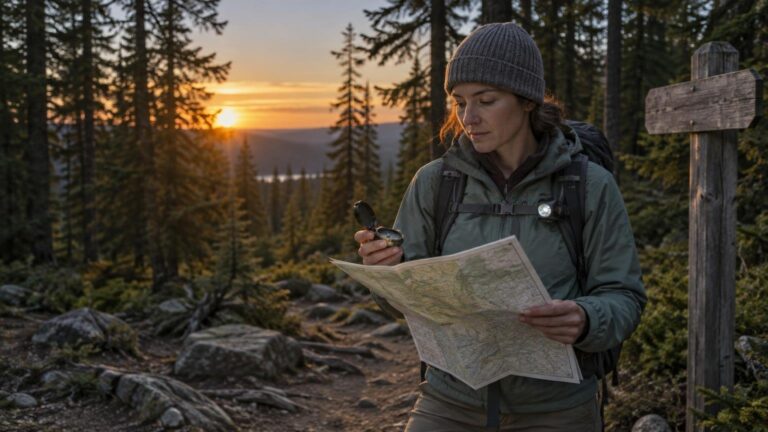
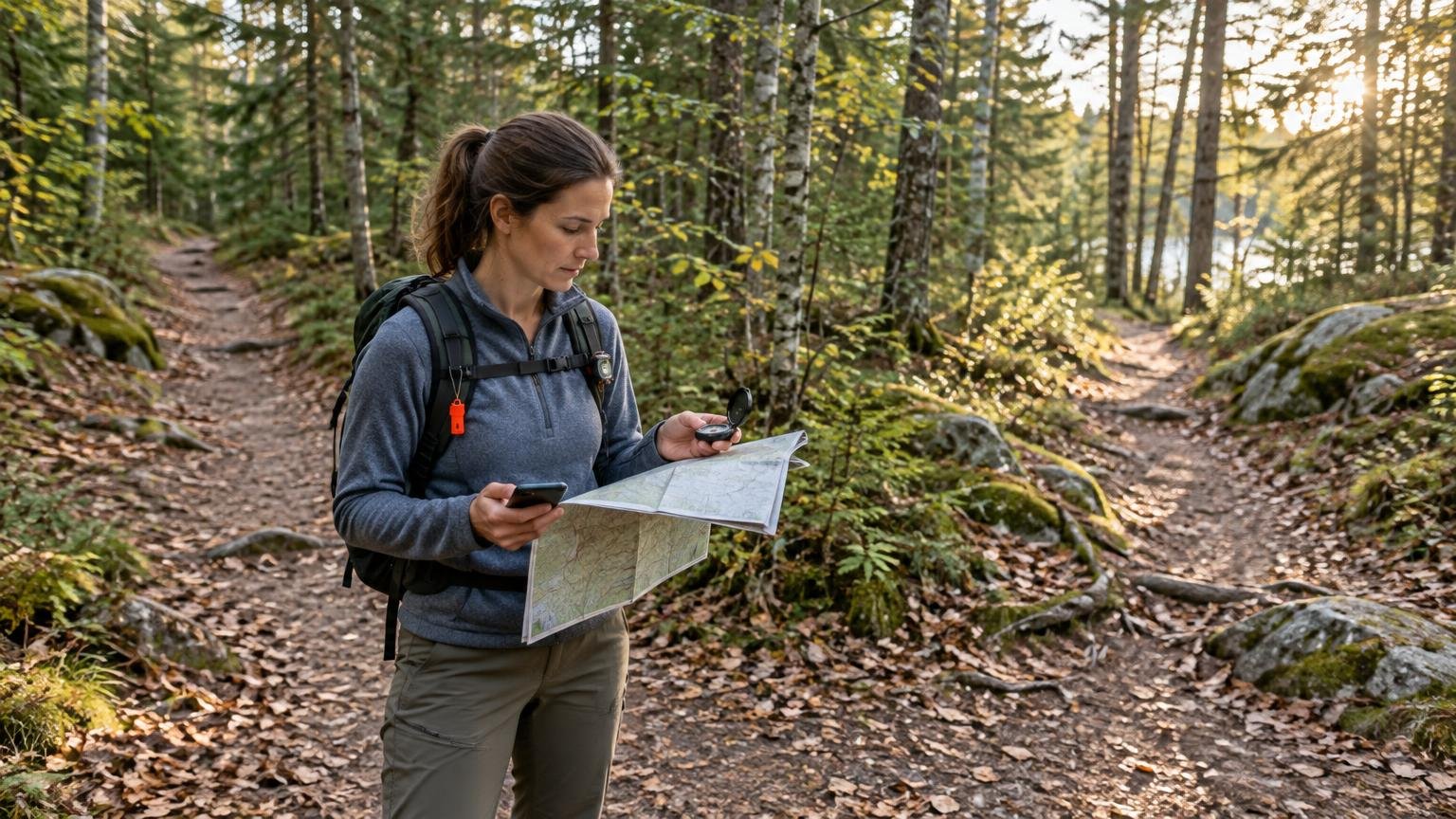
Use several clues rather than trusting one uncertain impression. Compare your paper map or offline map with trail direction, junctions, elevation changes, visible landmarks, and the distance you have traveled since the last confirmed location. Check your compass independently instead of assuming the trail must continue in the direction you expected.
A phone can be useful, but it should not be the entire plan. Wilderness cellular coverage may be patchy, so Olympic National Park advises against relying on a phone as the only route-finding or safety system. A downloaded map can still help without service, but a depleted battery, damaged phone, or inaccurate interpretation can remove that option.
Be especially cautious about a location that merely “looks right.” Similar switchbacks, drainages, and trail junctions can create false confidence. If your map, terrain, and remembered route do not agree, treat your location as unconfirmed.
Should you retrace your steps or stay put?
Retracing is reasonable only when you can identify the route you just traveled, the terrain remains safe, and you have enough light, energy, and weather margin to return to a confirmed point. Backtracking should mean following a known route—not choosing a general direction and hoping it reconnects with the trail.
| Situation | Safer default | Key condition |
|---|---|---|
| You can identify the route you just used | Retrace carefully | The route is known, safe, and still practical in the available daylight and weather |
| You cannot establish your location or route | Stay in a safe, visible place and contact help | Avoid expanding the search area through speculative movement |
| Your current location has an immediate threat | Move only as needed to reach a safer position | Record or communicate the move, direction, time, and new coordinates if possible |
| You are near a creek, drainage, or rising water | Do not assume following it is a safe exit | Water routes can lead into falls, steep terrain, crossings, or flood danger |
Do not descend a drainage or follow a creek simply because water seems likely to lead toward civilization. Olympic National Park warns that following rivers and creeks can be particularly dangerous. National Weather Service guidance also says to avoid floodwater and move to higher ground when flooding develops.
If you cannot find the trail, remaining in place generally gives responders and other hikers a more stable location to search. Yosemite National Park advises lost hikers to stay put and warns that leaving the trail increases both injury risk and the chance of becoming more lost. “Stay put,” however, is not a command to remain beside rising water, under an unstable tree, or in another immediate danger. If you must relocate, move only far enough to address the threat and make your change of position traceable.
Call for help before the situation becomes critical
In the United States, call 911 when you cannot safely recover the route, someone is injured or ill, dangerous weather is developing, or darkness and limited equipment are turning the situation into an emergency. Elsewhere, use the local emergency number or park dispatch procedure. Text-to-911 and direct park contacts are not available everywhere, so check local procedures before the hike.
Do not wait until the phone is nearly dead or conditions have become severe. Even an incomplete call may help if you lead with your location and problem. If service is weak, a text may sometimes transmit when a voice call does not, but availability and emergency-text support vary by location.
Give responders concise, specific information:
- Your GPS coordinates, including the coordinate format shown by the device
- The trail, park, trailhead, or access road where the hike began
- Your last confirmed location and the approximate time you were there
- Visible landmarks, signs, water features, elevation clues, or nearby structures
- The number of people in the group and whether everyone is together
- Injuries, medical conditions, medications, heat or cold symptoms, and other urgent needs
- Clothing colors, backpacks, shelters, lights, and other equipment responders might see
- Your intended route, destination, vehicle location, and expected return time
- Whether you plan to remain in place or must move because of an immediate hazard
These details match the information the National Park Service recommends sharing during an outdoor emergency. Follow the dispatcher’s directions rather than replacing them with general online advice.
Conserve power, warmth, water, and energy
Once help has been contacted—or while waiting for a signal—avoid unnecessary battery use. Dim the screen, close nonessential apps, and keep the phone protected from extreme heat, cold, and moisture. If responders have told you when to check in, follow that schedule. Do not enable a power-saving setting that prevents you from receiving an expected call without understanding what it disables.
Choose a waiting position that balances safety with visibility. Use available layers and rain gear before you become chilled, and keep insulation between your body and cold or wet ground when practical. Yosemite recommends carrying extra food and water, rain gear, and warm clothing in case a hike turns into an unplanned overnight.
Use water thoughtfully, but do not ignore heat symptoms merely to preserve your supply. The CDC recommends carrying and drinking water, taking breaks, and using shade in hot conditions. Warning signs of heat illness can include heavy sweating, cramps, dizziness, headache, weakness, and nausea. A worsening medical problem is a reason to update emergency responders if communication is available.
Make yourself easier to find
Visibility is part of the emergency plan. Place bright clothing or equipment where it can be seen without scattering essential gear or entering hazardous terrain. Use a whistle, light, reflective object, or signal mirror rather than exhausting yourself by shouting continuously.
Three repeated signals—such as three whistle blasts or three light flashes, followed by a pause—are commonly used as a distress call. Yosemite recommends repeated groups of three and a mirror or reflective object, while Olympic recommends bright visible items and a signal mirror. Repeat the signal periodically and whenever you hear people, aircraft, vehicles, or search activity.
If you hear rescuers, respond from your safe position rather than running toward a sound through unfamiliar terrain. More planning for trip contacts, signals, and search visibility is covered in how to make yourself easier to find during an outdoor emergency.
Let weather and daylight change your priorities
Approaching darkness
Darkness reduces your ability to recognize terrain and makes falls and navigation errors more likely. If the route is not confidently known, do not turn the last minutes of daylight into a rushed search for the trail. Use the remaining light to contact help, identify a safer waiting position, prepare layers, organize equipment, and make signaling gear accessible.
Rain and cold
Put on waterproof and insulating layers before you are soaked or shivering. Reduce exposure to wind and wet ground while avoiding unstable trees, flood-prone drainages, and other local hazards. A mild day can become a cold emergency when wet clothing, wind, fatigue, and an unplanned night combine.
Lightning
The National Weather Service says no place outdoors is safe while lightning is in the area. A substantial enclosed building or hard-topped vehicle is preferred when available, and outdoor activity should not resume until at least 30 minutes after the last thunder. If neither is accessible, contact emergency personnel when possible and make decisions based on the actual terrain rather than following a universal relocation rule that may expose you to a different hazard.
Flooding
Do not enter moving water or attempt an uncertain crossing to regain the route. Rain can create danger downstream or in a drainage even when little rain is falling at your exact position. If water is rising, prioritize moving away from the flood threat and toward higher ground, then communicate your changed location if possible.
Build a simple backup system before every hike
Knowing what to do if lost on hiking trail terrain helps, but the best response begins before leaving the trailhead. A basic backup system does not need to be complicated or expensive. It needs independent ways to navigate, communicate, stay warm, see after dark, and tell someone where to start looking.
- Leave a trip plan with a reliable person, including the trailhead, intended route, vehicle description, party members, expected return time, and when they should seek help.
- Check the official forecast, current trail notices, sunset time, fire restrictions, flood concerns, and local emergency contacts shortly before departure.
- Carry an appropriate paper map and compass, and know how to use them. Add a downloaded offline map rather than treating it as the sole navigation system.
- Start with a charged phone and consider a suitable power backup. For remote routes, evaluate whether a satellite communication device fits the terrain and risk.
- Carry a headlamp or flashlight even for a day hike, plus weather-appropriate layers and rain protection.
- Bring sufficient water and food for the planned route, with a reasonable margin for delay based on the conditions and people in the group.
- Carry a whistle, a bright or reflective item, basic first aid supplies, essential medications, and any personal medical information responders may need.
- At junctions, confirm the route before moving on. Photograph signs when useful and periodically compare your actual progress with the plan.
The practical takeaway
Getting turned around is a navigation problem; continuous uncertain movement can turn it into an emergency. Stop early, keep the group together, establish your last known point, and retrace only a route you recognize as safe. If that cannot be done confidently, call for help and remain in a safe, visible location unless an immediate hazard requires a limited move.
Before your next hike, make one concrete improvement: download the map, pack a light and whistle, add a warm layer, or send a complete itinerary to someone who will notice if you are overdue. Simple backups preserve your options when the trail no longer looks familiar.
References
- Outdoor Emergency Plan (U.S. National Park Service)
- Wilderness Safety – Olympic National Park (U.S. National Park Service)
- Outdoor Activities: Flooding Safety and Preparedness
- Wilderness Safety – Yosemite National Park (U.S. National Park Service)
- About Heat and Your Health | Heat Health | CDC
- Lightning Safety and Outdoor Sports Activities