
Texting vs Calling During an Emergency: Build a Family Communication Strategy
TLDR: The simplest text vs call emergency communication rule is to text separated family members for routine check-ins, call when an immediate conversation is necessary, and call 911 when police, fire, or emergency medical assistance is needed. Text-to-911 is a fallback only when calling is not possible and the service is available locally. Support that rule with an out-of-area contact, printed information, backup charging, an independent source of official alerts, and regular practice.
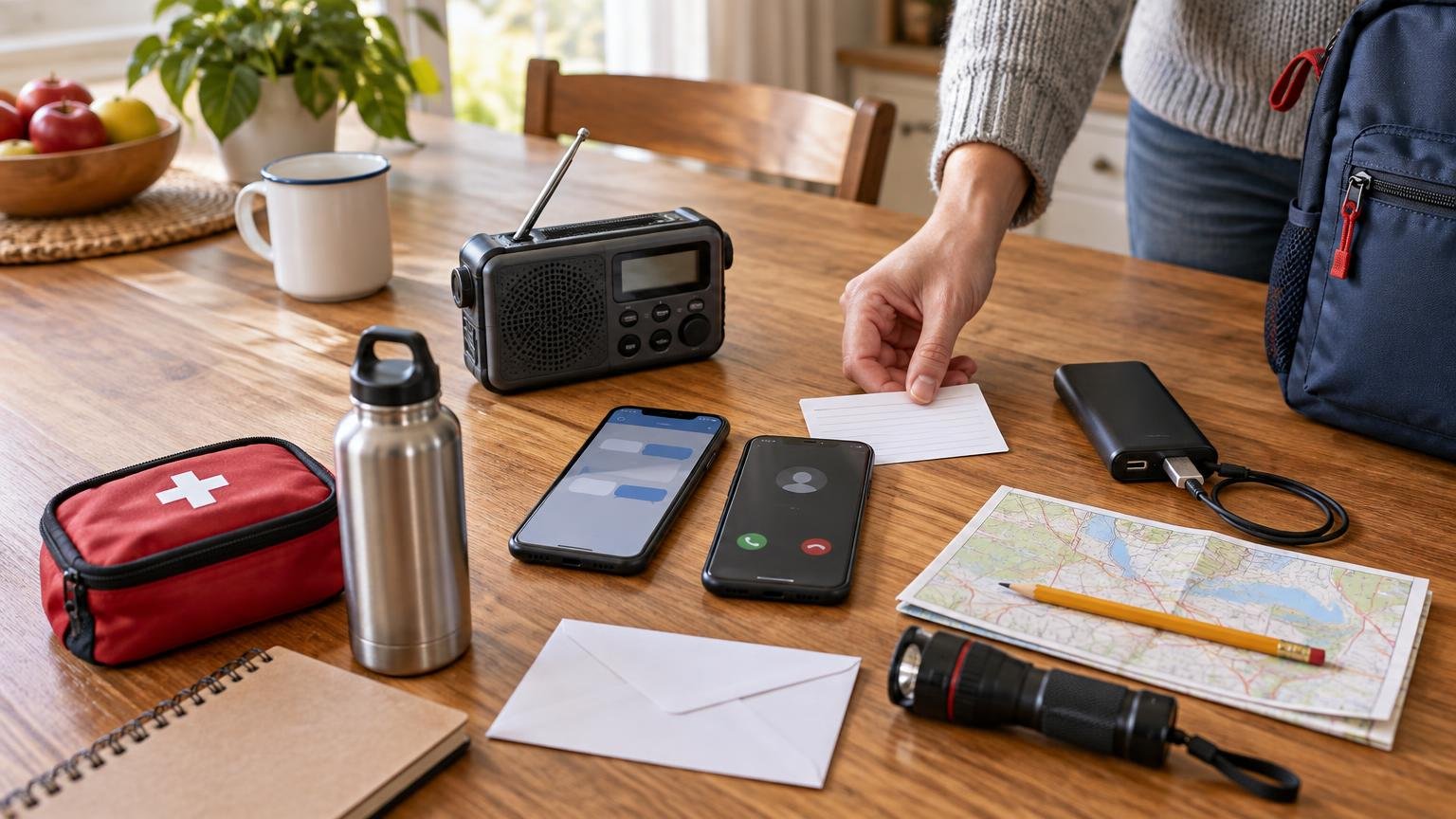
A resilient family strategy does not depend on one phone, app, network, or person remembering every detail. It assigns each communication method a job. Brief text messages handle routine status updates efficiently, voice calls resolve urgent or complicated questions, and 911 connects people with emergency services. Paper copies, radios, meeting places, and backup power keep the plan useful when normal systems are disrupted.
Text vs call emergency communication: the basic decision
| Situation | First choice | What to do |
|---|---|---|
| Family members are safe but separated | Text | Send a short status update with your condition, location, battery level, destination, and next check-in time. |
| A decision requires immediate discussion | Call | Use a voice call when details are changing quickly, instructions are difficult to explain by text, or confirmation cannot wait. |
| Police, fire, or emergency medical help is needed | Call 911 | Call 911 if possible. Give the location and nature of the emergency, then follow the call-taker’s instructions. |
| You need emergency services but cannot safely or practically speak | Text 911 where available | Use Text-to-911 only if calling is not possible and local service is available. Include a precise location and concise description. |
| Cellular communication is unavailable | Use the next layer | Follow the household meeting plan, contact the designated relay when service returns, and monitor official information through a pretested alternative. |
The National 911 Program advises people to call 911 when possible and text only when a voice call is not possible. Text-to-911 availability depends on the local emergency call center, so do not assume it works everywhere. Check the official procedures for the places where your household lives, works, studies, or regularly travels, and never send a non-emergency test message to 911. Review the National 911 Program’s calling and texting guidance.
A text-first family check-in rule does not mean text-first emergency response. Contacting a relative is not a substitute for requesting police, fire, or medical assistance. If someone needs emergency help, contact 911 first when possible; update the family afterward when doing so will not delay care or put anyone in danger.
Build a six-layer family communication ladder
Instead of searching for one perfect device, build layers that fail in different ways. Write the following order into your household plan so each person knows what to try next.
- Emergency response: Call 911 for an immediate police, fire, or medical emergency. Use Text-to-911 only when calling is not possible and local service supports it.
- Household check-in: Send a concise text to the family group or designated coordinator when you are safe. Avoid repeated messages that add confusion.
- Out-of-area relay: Contact one person outside the affected area who can collect updates and pass them between separated household members.
- Official information: Monitor local emergency alerts, weather warnings, evacuation instructions, school notices, and utility messages through the relevant local systems.
- Offline plan: Use printed phone numbers, addresses, meeting places, medical details, and maps when a phone is unavailable or stored information cannot be opened.
- Backup power and alternate equipment: Preserve priority phones with charged power banks, correct cables, safe charging options, and a tested weather radio.
Ready.gov planning materials support identifying an out-of-area contact, keeping contact information accessible, establishing meeting places, and practicing the plan. Text messages are particularly useful for routine family communication when nobody is in immediate danger.
Choose an out-of-area contact and two meeting places
Choose a primary relay contact who is likely to be outside the same disruption. Add a backup in case the first person is unavailable. Give both contacts a current household roster and explain their role: record who has checked in, relay short updates, and avoid circulating unconfirmed information.
Select two meeting locations. One should be close to home for a localized problem such as a building evacuation. The second should be outside the immediate neighborhood in case roads are closed or the area is inaccessible. Specify the full address rather than relying on a nickname such as “the park.” Decide whether people should go to a meeting place automatically or wait for instructions; the safer choice can vary with the hazard.
Use a standard emergency check-in text
A useful message answers the questions that otherwise trigger several follow-ups. Agree on this format before an emergency:
ALEX — SAFE. At Northside Library, 123 Main Street. Battery 42%. Staying here until 4:00 p.m.; then going to the Oak Street meeting place if safe. Next update at 3:30 p.m.
The six useful fields are name, condition, exact location, battery level, intended movement, and next update time. Keep the message factual. If an expected update does not arrive, the plan should say who tries to call, who contacts the out-of-area relay, and when the situation warrants contacting authorities. A missed text alone does not reveal why someone is unreachable.
Set a check-in rhythm that fits the event. Constant messaging consumes attention and battery power, while updates spaced too far apart create uncertainty. A household might agree to report after reaching a safe location and again at a stated time. The message itself should establish the next deadline.
Assign every device and supply a role
Equipment becomes more useful when the family knows what it is for. Avoid collecting chargers and radios without testing whether they work together.
- Smartphone: Primary tool for 911 calls, family texts, voice calls, official alerts, maps, and contact information while networks and power remain available.
- Power bank: Reserved for priority communication devices rather than entertainment. Store it with the correct charging cable and inspect it according to its manufacturer’s directions.
- Wall charger and cables: Keep a known-working charging setup together. Label cables if household devices use different connectors.
- Vehicle charger: A possible secondary option when the vehicle and location can be used safely. Never run a vehicle in a garage or other enclosed space.
- NOAA Weather Radio: An independent channel for weather and hazard information when internet access is limited. Reception and transmitter status depend on location.
- Paper plan: A non-powered copy of essential contacts, addresses, meeting locations, and procedures.
- Two-way radios: An optional local communication layer for household members who have tested range, channels, batteries, and operating rules in the locations where they expect to use them. They do not replace phones or 911.
The American Red Cross and CDC recommend preparing power and communication resources for outages, including charging equipment, batteries or power banks, appropriate vehicle charging options, and battery-powered or hand-crank radios. For a deeper way to ration stored energy across several days, use this emergency phone charging plan for a multi-day outage.
Create a battery and charging worksheet
Do not build the plan around a generic promise that a power bank will provide a fixed number of phone charges. Results vary with the phone, battery condition, temperature, conversion losses, cable quality, background activity, and whether the phone is being used while charging. Record what you own, then test the actual combination under ordinary conditions.
| Item | Communication role | Capacity or battery type | Required connection | Priority | Last tested |
|---|---|---|---|---|---|
| Primary phone | 911 and household contact | Record device battery specification if known | Record cable and charger | 1 | Date |
| Backup phone | Secondary household contact | Record specification if known | Record cable and charger | 2 | Date |
| Power bank | Recharge priority phone | Use labeled stated capacity | Input and output cables | 1 | Date |
| Weather radio | Receive official hazard information | Battery size, rechargeable pack, or hand crank | List batteries or charging input | 2 | Date |
| Two-way radios | Short-range household contact | Battery type for each unit | Charger or spare batteries | 3 | Date |
Keep the worksheet beside the equipment. Confirm that every required cable is physically present, not merely owned somewhere in the house. If several people depend on one power bank, establish charging priority in advance. Emergency calls, essential updates, accessibility functions, and critical care coordination should take precedence over nonessential use.
Keep essential information available without a phone
A phone can be charged yet still be lost, damaged, locked, or unable to reach cloud-stored files. Print a compact household plan and place copies in sensible locations such as emergency kits, wallets, school bags, and a secure home file. Balance access with privacy; not every copy needs a complete medical history.
- Names and phone numbers for household members
- Primary and backup out-of-area contacts
- Full addresses for both meeting places
- School, caregiver, workplace, and essential service contacts
- Actionable medical, medication, allergy, mobility, or communication information where appropriate
- Local emergency-management and utility contact details
- Evacuation destinations and relevant paper maps
- The household check-in rule and communication ladder
A concise emergency information card can also keep essential contacts and carefully selected medical details available in a vehicle. Store broader communication supplies with the rest of your 72-hour emergency kit so the plan and equipment are easy to find together.
Add NOAA Weather Radio as an information backup
NOAA Weather Radio can provide weather and hazard information without depending on a household internet connection, but reception is location-specific. Test the radio in the rooms where you expect to use it, learn its alert settings, identify the relevant local transmitter, and check reported transmitter outages. The National Weather Service provides NOAA Weather Radio coverage and outage information.
A weather radio is an information channel, not a way to contact family or request emergency help. Keep it alongside phone-based local alerts rather than treating either method as sufficient on its own. If indoor reception is poor, determine whether another location in the home works before an emergency.
Test and maintain the plan
A plan that has never been practiced is a collection of assumptions. Use a simple maintenance rhythm that is frequent enough to catch dead batteries, changed numbers, missing cables, and unclear instructions.
- Monthly: Check charge levels, inspect batteries, confirm cables fit, power on the radio, and verify that printed copies remain accessible.
- Seasonally: Review contacts, meeting places, local alert enrollment, radio reception, evacuation destinations, and household needs.
- Twice yearly: Run a short check-in drill. Have each person send the standard message, contact the relay, and explain what happens if phones fail.
- After a change: Update the plan following a move, new school or job, phone replacement, changed caregiver, new medical equipment, or altered mobility and communication needs.
Do not test 911 or Text-to-911 as part of a household drill. Practice the wording using a family member’s number, and verify local emergency-service procedures through official public information.
One-page family action checklist
- Write down when to text family, when to call, and when to call 911.
- Confirm local Text-to-911 availability without sending a test message.
- Choose primary and backup out-of-area contacts.
- Select one nearby and one out-of-neighborhood meeting place.
- Adopt a standard status-message format and check-in rule.
- Inventory phones, power banks, cables, chargers, batteries, and adapters.
- Test NOAA Weather Radio reception and alert settings at home.
- Print essential contacts, full addresses, instructions, and appropriate medical details.
- Place copies and communication equipment where household members can reach them.
- Run the plan twice a year and update it whenever household needs change.
Start with the decisions, not the shopping list. Agree on who contacts whom, what each message contains, where people meet, and which channel comes next when the first one fails. Then support those decisions with tested charging equipment, official information sources, and printed backups.
Households with power-dependent medical equipment, accessibility requirements, or specialized communication needs should make an individualized plan with the relevant clinicians, equipment providers, utility, caregivers, and local emergency-management office. The goal is not merely to keep a phone charged; it is to preserve access to the communication and support each person actually needs.
